
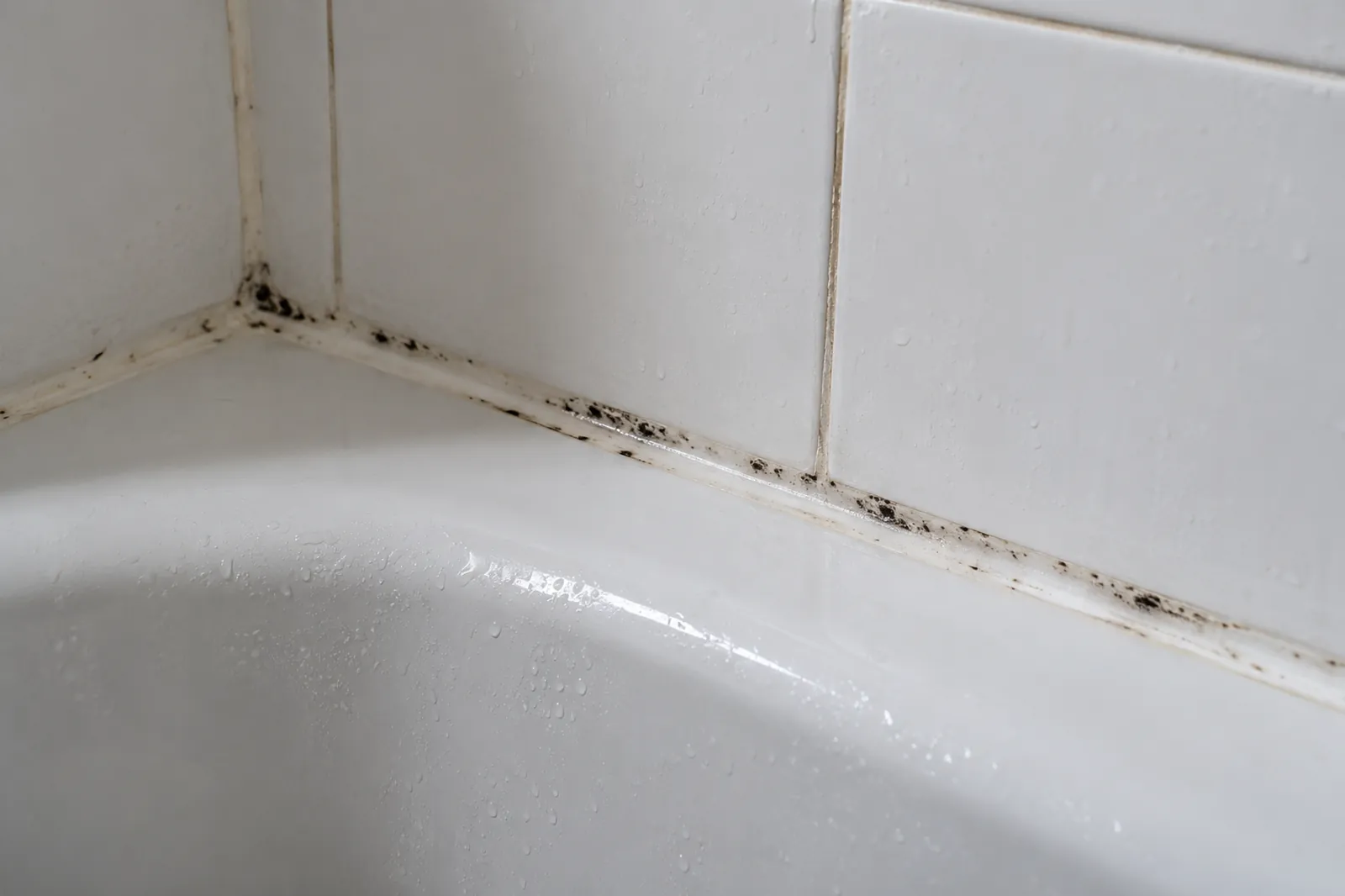
To remove black mould from silicone sealant or a window seal, open the window, shut the door, put on gloves, a mask and goggles, and work one mould and mildew cleaner into the seal with a soft brush. Leave it for the time on the label, rinse it off and dry the seal completely. If the black is still there under a clean surface, the mould is inside the silicone, and the fix is to cut the bead out and reseal.
We clean sealant on every deep clean and every end of tenancy clean, in London, Manchester and Liverpool. Bathroom silicone goes black in any month. Window seals start going black once the heating is on and the windows stay shut, and Wandsworth Council puts it plainly: damp and mould are more likely to be a problem in the cold winter months.
Surface mould, or mould inside the silicone?
Black mould on sealant is mould growing on the bead, in it or behind it, and where it sits decides the fix. Silicone is slightly porous. Michael Zohouri of Pyramid Eco told Homebuilding & Renovating that once mould has grown into it, it cannot be removed, and UniBond, which makes sealant, says sealant with mould set too deeply in it will need to be removed and replaced.
The test is simple. Clean a short length properly, let it dry and look again in daylight. Specks that have gone were on the surface. Grey or black that still sits under a smooth, clean bead is inside it, and no spray will reach it.
| Where the black is | What you see | What fixes it |
|---|---|---|
| On the surface | Dark specks or a film that fade as the cleaner works | Clean it (steps below) |
| Inside the silicone | Grey or black under a clean, smooth bead | Cut the bead out and reseal |
| Behind the bead | Black along an edge where the bead has lifted off the tile or bath | Reseal onto a dry joint, and look for a leak |
| In a window gasket | Black in the groove of the rubber strip round the glass | Clean and dry it, then cut the condensation |
| On the frame, sill or wall | Black spreading off the seal onto paint or plaster | Treat it as a damp problem, and report it if you rent |
Cleaning mould off bathroom silicone, step by step
The government’s damp and mould guidance, written with the UK Health Security Agency, says mould and mildew products should be used in preference to bleach, and that whoever removes the mould should wear a mask, gloves and goggles. Keep the door shut so spores don’t spread round the home, and the window open during and after the clean (UKHSA and OHID, damp and mould guidance).
- Open the window, shut the door, and put on gloves, a mask and goggles.
- Wash the bead with warm water and a drop of washing-up liquid, then dry it. Shampoo and soap film sitting on top keeps the mould cleaner off the mould.
- Apply one mould and mildew cleaner along the bead and leave it for the time on the label. One product only.
- Work it in with a soft old toothbrush. No scourer and no blade on a bead you intend to keep.
- Rinse with clean water and dry the bead with a cloth, then wash that cloth hot or throw it away. Wandsworth’s advice is never to reuse a cloth that has touched mould.
- Leave the extractor fan running or the window open until the joint is completely dry.
If a line is still grey after a second go, stop there. More scrubbing won’t move mould that is inside the silicone, and it wears the bead down.

Black mould on window seals
Anglian, the window company, says the most likely cause of mould on windows is condensation, and that if you can stop the condensation the mould won’t grow. For the seals it suggests a 50-50 mix of warm water and Milton fluid on a soft cloth, which it says removes the mould and keeps the silicone and seals in good condition.
Milton’s active ingredient is sodium hypochlorite at 2% (product listing), the chemical in household bleach, so the mixing rules further down apply to it as well.
The rubber gasket round the glass is where most of it hides. Wrap the cloth round a cotton bud and run it along the groove, then dry the groove the same way, because water left sitting in it is what turns it black again. Don’t lever the gasket out to get behind it.
Then deal with the water. Wandsworth’s advice is to wipe windows and sills with a clean dry cloth each morning and never to cover air vents. Our damp and mould page has the rest of the winter condensation routine, along with the government’s 2024 estimates of how many privately rented homes in each London borough have damp.
What the popular remedies do
Never mix cleaning products. UKHSA’s information on sodium hypochlorite warns about the gases formed when bleach meets an acid such as vinegar (chlorine) or a cleaner containing ammonia (chloramines). Rinse one product off completely before anything else touches the seal.
Bleach is where the advice splits: Wandsworth suggests one part bleach to four of water, and the national guidance prefers mould and mildew products. Plenty of mould sprays are chlorine-based anyway (the budget pick in Homebuilding’s guide lists sodium hypochlorite), so read the label. If it says sodium hypochlorite or chlorine, it counts as bleach. The kitchen roll trick, bleach-soaked strips pressed onto the bead overnight, is bleach too, and on an upright joint the paper slides off.
A fizzing paste of vinegar and bicarbonate of soda is the other favourite. Which? explains that the two neutralise each other and the bubbles are carbon dioxide. The expert in the Homebuilding piece is blunter: once mould is growing into the silicone, vinegar won’t touch it.
When the sealant has to come out
Once the black is inside the bead, resealing is the fix. UniBond’s method is to scrape off as much old sealant as you can, clear the residue with a sealant remover, wipe the joint with white spirit, run a new bead in one steady line and smooth it straight away. Then check the product’s instructions for how long it needs to cure before water touches it.
Let the joint dry fully before the new bead goes on, choose a sanitary sealant sold as anti-mould, and sort the ventilation at the same time. We don’t reseal ourselves; it is a job for a handyperson or a plumber, or a careful afternoon of DIY.
Renting? Mould on sealant at check-out
Inventory clerks check the sealant round the bath, basin and shower. On the check-out reports we see, black and crumbling sealant reads as a maintenance issue for the landlord, grimy sealant that cleans up reads as cleaning, and the line between the two gets argued. Our guide to what London inventory clerks check covers the rest of the bathroom.
The record you keep during the tenancy decides most of these. Report mould to your landlord in writing when it first appears, keep a copy and photograph it with the date. The check-out evidence pack lists the photos worth having at the end.
Our end of tenancy clean, from £156 for a studio, cleans the sealant and grout along with everything else on your check-in inventory. It doesn’t reseal and it doesn’t treat damp, and mould caused by a fault in the building is the landlord’s to fix. Where there’s no free parking, we add just what parking costs us. If you own the home, a deep clean does the same bathroom work, and if the grout has gone black right through, the cleaner tells you, because scrubbing won’t bring it back.
Questions we get asked
Is black mould on window seals dangerous?
It can be, mostly for breathing. UKHSA’s guidance says damp and mould primarily affect the airways and lungs and can also affect the eyes and skin, and that people with certain health conditions, children and older adults are at greater risk. Most people can clean a very small patch on a seal themselves. The same guidance says larger areas should only be dealt with by qualified professionals, and that removing surface mould will not stop it reappearing unless the damp behind it is dealt with.
Does bleach kill mould on silicone?
Bleach can lift surface mould, and some councils, Wandsworth among them, suggest a one-to-four bleach solution. The national guidance prefers mould and mildew products. Neither reaches mould growing inside the bead, which is why a grey line comes back after every clean. Whatever you use, never combine bleach with vinegar, other acids or ammonia-based cleaners.
Why does the mould keep coming back on my sealant?
Usually because the joint never dries. A bead that stays wet between showers, or a window seal with condensation running down it every morning, will grow mould again however well it was cleaned. The other reason is mould inside the silicone, which cleaning can’t reach. Ventilate, dry the bead after use, and reseal if the black sits under the surface.
Is mould on the sealant the tenant’s problem or the landlord’s?
It depends on the cause and on the evidence. A landlord has to keep the home fit to live in, and mould from a leak or a building fault is theirs to fix. A deduction at check-out needs the landlord to show the tenant caused the mould or made it worse, for example by never reporting it. Report it in writing as soon as you see it. Our damp and mould page covers the rules, including where Awaab’s Law stands for private renters.
Sources
- GOV.UK (UKHSA and OHID), Understanding and addressing the health risks of damp and mould in the home, updated 1 April 2026
- GOV.UK (UKHSA), Sodium hypochlorite: general information, updated 24 April 2025
- Wandsworth Council, damp, mould and condensation, updated 23 September 2026
- UniBond, How to clean silicone sealant
- Homebuilding & Renovating, How to remove black mould from silicone sealant, updated 13 October 2025
- Anglian Home Improvements, Mould on windows
- Medino, Milton Sterilising Fluid (active ingredient listing)
- Which?, Things you should never clean with bicarbonate of soda, 11 June 2026
- Monster Cleaning, Damp and mould in London’s rented homes