
Start with the cleaning code on the sofa’s label. W means water-based cleaners are fine, S means solvent only, WS means either, and X means vacuum only. On a W or WS sofa, vacuum everything first, test your cleaner on a hidden patch, then dab the marks with a cloth that has been wrung out hard. Finish by wiping each panel from seam to seam so the edge of the clean patch can’t dry into a tide mark, and let the sofa dry in moving air, away from heaters.
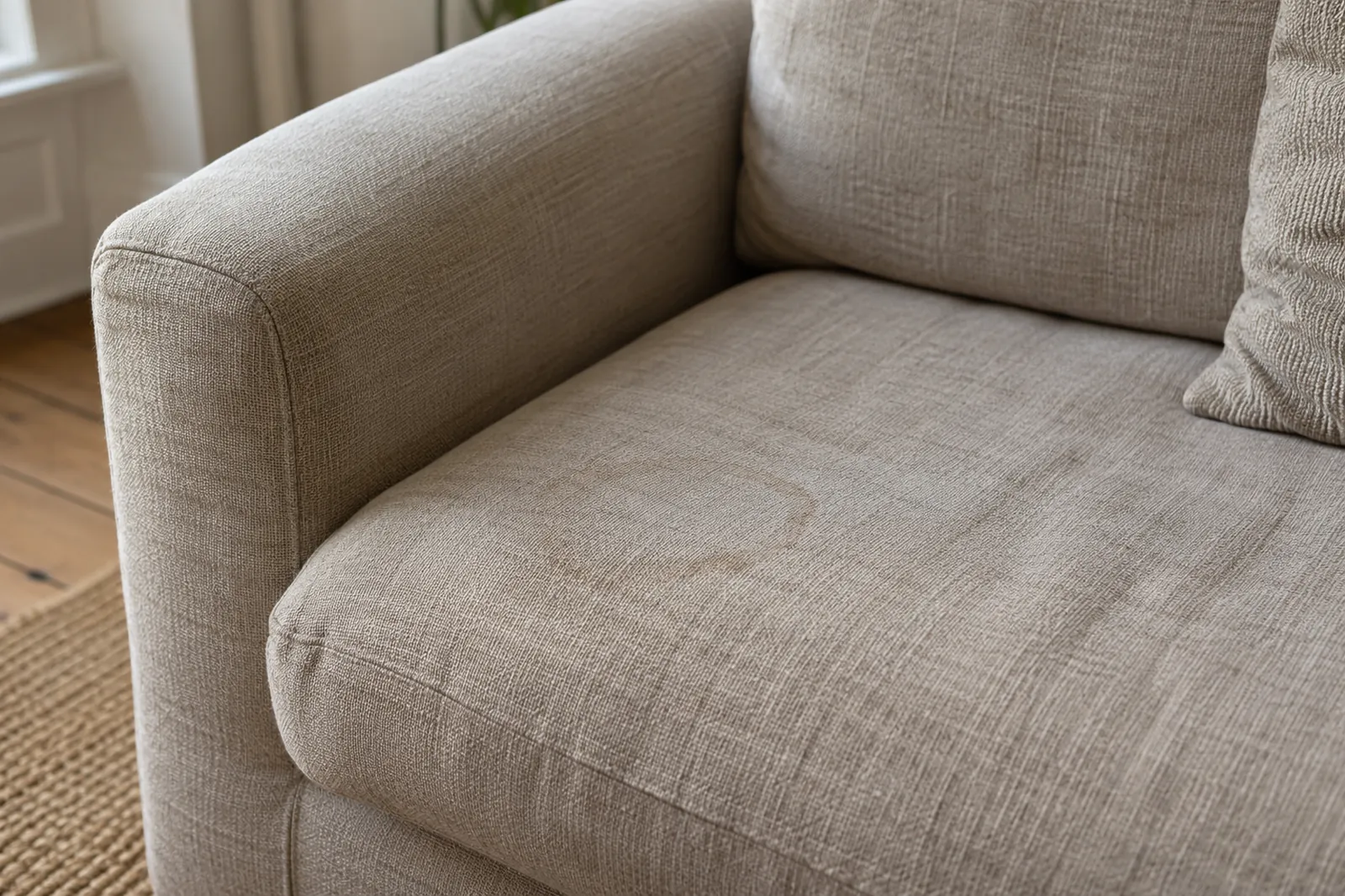
On our sofa cleans, the cleaner reads the fabric and its care label before anything wet touches it, and tests a hidden patch first. The method below is the by-hand version of that clean, with the codes and cautions taken from sofa makers and retailers, Which? and the companies that make upholstery cleaning machines.
Find the cleaning code first
The code is a letter or two on a fabric tag. Plumbs, which makes loose covers, finds it tucked down the side of a seat cushion next to the arm, or round the back of the sofa. Where the cushions are sewn to the frame, the tag is usually on the platform underneath them. If it has been cut off, the maker’s website should have the cleaning instructions.
| Code | What it means | What you can do at home |
|---|---|---|
| W | Water-based cleaners can be used (Which?) | Spot clean with water and a little mild detergent or an upholstery shampoo, using as little water as the job allows |
| S | Solvent-based cleaners only. Oak Furnitureland specifies a water-free dry cleaning solvent | Keep water off it. Rug Doctor tells people hiring its machines not to use the upholstery tool on S or X fabric, and to ask the manufacturer |
| WS (also W/S, S-W or W-S) | Either water-based or solvent-based cleaners (Which?) | The water-based method below, after a patch test |
| X | Vacuum only (Which?), or vacuum and a soft brush (Oak Furnitureland) | A vacuum and a brush, and nothing wet. When our cleaners find an X label, the piece gets a vacuum and nothing more |
Zips on the cushions don’t make the covers washable. Oak Furnitureland says to leave them on the sofa unless the care label says they can be washed, because machine washing can shrink or fade them. Plumbs adds that a fitted cover cleaned on its own can shrink or tear. If a cover does have a washing label, our washing symbols guide explains each symbol on it.
Vacuum before anything wet goes on
Take the cushions off and vacuum both sides of each one with the soft brush or upholstery attachment, as Which? does, then the arms, the back and the gap down the sides where the crumbs collect. Oak Furnitureland keeps the suction low, and warns against pressing down on velvet, which flattens the pile. Get every bit of grit out. Dry grit turns to mud once water reaches it, which is how tide marks start.
Cleaning a fabric sofa by hand, step by step
For a W or WS sofa you need warm water with a little mild washing-up liquid or upholstery shampoo, a bowl of clean water and a pile of white or colourfast cloths. Dye from a coloured cloth can rub off onto pale fabric.
- Test the solution on a hidden patch, such as the back of the sofa or the underside of a cushion, and let it dry completely before you judge it (Oak Furnitureland). If colour comes off on the cloth or the fabric changes, stop there.
- Put the solution on the cloth and wring it out well. Plumbs puts cleaners on the cloth, because applying them straight to the fabric can wear or discolour it, and warns that too much water can damage the foam inside.
- Dab each mark, working from the outside edge in. Don’t scrub. Which? says scrubbing can damage the fabric, and Kärcher says rubbing pushes the liquid deeper into the fibres.
- Dab the same spot with a second cloth dampened in clean water. Kärcher finishes grease marks this way, so no washing-up liquid is left in the fabric.
- Wipe the whole panel, from seam to seam, with a fresh damp cloth. Sofology does this after every spot clean to stop water marks forming, and Kärcher’s rule for machine cleaning works the same way: wet connected areas completely, so no edge dries on its own.
- Give the arms and headrests the most time. Skin and hand oil make them the dirtiest part of most sofas, and they are the part people miss when they clean it themselves.
- Dry it in moving air. Which? opens the windows to get the sofa dry quickly so it doesn’t pick up a mildew smell, and warns against a heater or hairdryer, because the fabric may be sensitive to heat. Stand loose cushions on their edges and keep everyone off until the fabric is dry.
Plumbs suggests distilled water where you can get it, because tap water can leave rings.

Where water marks come from
Usually from too much water, or from cleaning only part of a panel. Oak Furnitureland traces water marks to excess moisture during cleaning, and suggests a professional clean if they are still there once the sofa is dry. On our jobs, a ring on a cushion is usually a tide mark left by a partial clean, and it can often be fixed. Keep the foam dry as well: a cushion core that has been soaked through takes days to dry and can go mouldy.
Stains that need a different approach
- Coffee and tea. Blot as much as the cloth will take, then use foam from washing-up liquid whisked in water, which cleans without soaking the cushion. Our guide to coffee stains on a sofa goes through it.
- Blood needs cold water. Kärcher warns that warm water makes the protein in blood coagulate, which binds it to the fibres.
- Grease and food: washing-up liquid mixed with water and massaged in from the edge of the mark, then dabbed off with clean warm water (Kärcher).
- Pet urine and sick call for an enzyme cleaner. Which? says enzyme cleaners break down organic matter, so they work on smells from pets, urine or vomit. Once urine has soaked into the foam, cleaning reduces it, but the foam insert may need replacing to get rid of it completely.
- Bleach marks stay. The fibre itself has lost its colour, and only a specialist can recolour it.
Bicarbonate, vinegar and the saucepan lid trick
For smells, both Which? and Kärcher reach for bicarbonate of soda. Which? sprinkles it finely over the whole sofa, leaves it for a few hours or overnight and vacuums it up; Kärcher leaves it on single stains overnight. For stubborn marks, Which? uses one part white vinegar to three parts water. Oak Furnitureland is more cautious: it says vinegar, bicarbonate of soda and washing-up liquid don’t suit every fabric and can discolour some. They all get the same patch test as anything else.
The saucepan lid trick from social media has its critics. A cloth dipped in diluted laundry detergent and wrung out is tied tight over a pan lid, then dragged across the cushions. In Ideal Home, Deirdre McGettrick, co-founder and chief executive of ufurnish.com, warned that it lets moisture travel deeper than the cover, where mould can grow if the sofa doesn’t dry properly. The detergent is never rinsed out of the fabric either.
A steam cleaner is for W or WS sofas only, says Which?, after a patch test. Kärcher checks a hidden spot first in case the fabric reacts to heat, and Oak Furnitureland warns that heat and moisture together can damage delicate fabrics or shrink them.
Spot cleaning machines, and hired carpet cleaners with an upholstery tool, suck the dirty water back out, which a cloth can’t. Rug Doctor limits its upholstery tool to fabric coded W or W/S, tested first on a hidden area. For the machines and sprays worth buying, see our round-up of the best upholstery cleaners.
Velvet, leather and other covers that need a lighter hand
Velvet wants less of everything. Which? brushes it with a soft velvet brush in the direction of the pile, blots stains with a clean cloth and uses a velvet cleaner only if blotting doesn’t work. Leather is a different job altogether. Kärcher wipes it with a damp cloth and neutral soap dissolved in lukewarm water, and keeps washing-up liquid off it because it can dry the leather out. Which? conditions leather every six to twelve months. On our cleans, leather never goes near the extraction wand: it is cleaned by hand and then conditioned.
Having your sofa cleaned for you
Our upholstery cleaning is priced per piece: £57 for a two-seater sofa, £83 for a three-seater and £33 for an armchair. A visit starts at £67, so a two-seater booked on its own comes to £67. The cleaner checks the label and tests a hidden patch, then lets a pre-spray chosen for the fibre and the mess sit for about ten minutes. It comes out with a small upholstery wand: two passes on a moderately dirty sofa, three on the worst patches. Most sofas can be sat on again three to four hours later. If we can’t park for free near you, we add the parking at exactly what we pay.
If you are leaving a furnished flat, check the inventory first. If it records the sofa as clean at check-in, the landlord can expect it clean at check-out. Booked with an end of tenancy clean, a two-seater is £51 and an armchair £24.
Questions we get asked
Can baking soda clean a sofa?
It freshens a sofa more than it cleans one. Which? sprinkles it over the whole sofa to absorb odours, leaves it for a few hours or overnight, then vacuums it up. Kärcher also makes a paste of a tablespoon of bicarbonate of soda and a tablespoon of water for single stains, lets it dry and vacuums it off. Test it on a hidden patch first, because Oak Furnitureland says it doesn’t suit every fabric.
What is a good homemade cleaner for a fabric sofa?
Warm water with a little mild washing-up liquid, on a W or WS sofa only. Sofology’s fallback when there is no care kit is warm soapy water, finished with a seam-to-seam wipe of clean water. For stubborn marks Which? uses one part white vinegar to three parts water. Keep both off S and X fabric.
How do you clean a sofa without leaving water marks?
Use less water and clean whole panels. Put the solution on the cloth and wring it out, dab the mark, then wipe the entire panel from seam to seam with clean water so no edge dries on its own. Dry the sofa quickly in moving air.
How often should a sofa be cleaned?
Vacuum it every week, which Sofology and Plumbs both suggest, and deal with spills as they happen. Which? suggests a deep clean and deodorise once or twice a year. For a professional clean, every 12 to 18 months suits most households, or every 9 to 12 months with pets, young children or anyone with allergies at home.
Sources
- Which?, How to deep clean a sofa by hand, updated 7 April 2026
- Oak Furnitureland, How to clean a fabric sofa, 20 July 2026
- Plumbs, How to read furniture cleaning codes, updated 22 April 2024
- Sofology, How to care for your fabric sofa, 28 January 2025
- Kärcher UK, Cleaning upholstery
- Rug Doctor, Carpet cleaner and upholstery tool rental instructions, updated 28 May 2025
- Ideal Home, Why the viral sofa cleaning hack might do more harm than good, 10 July 2023