
UK law doesn’t give a number. The Workplace (Health, Safety and Welfare) Regulations 1992 say an office and its furniture must be kept sufficiently clean, and the Health and Safety Executive (HSE) leaves the frequency to the nature of the business. On the office contracts we run, the washrooms, kitchen, bins and the surfaces people touch are done on every visit. Every carpet is vacuumed edge to edge once a week, glass and high-level dusting come round monthly, and carpets and hard floors get a deep clean every three months where the office needs it.
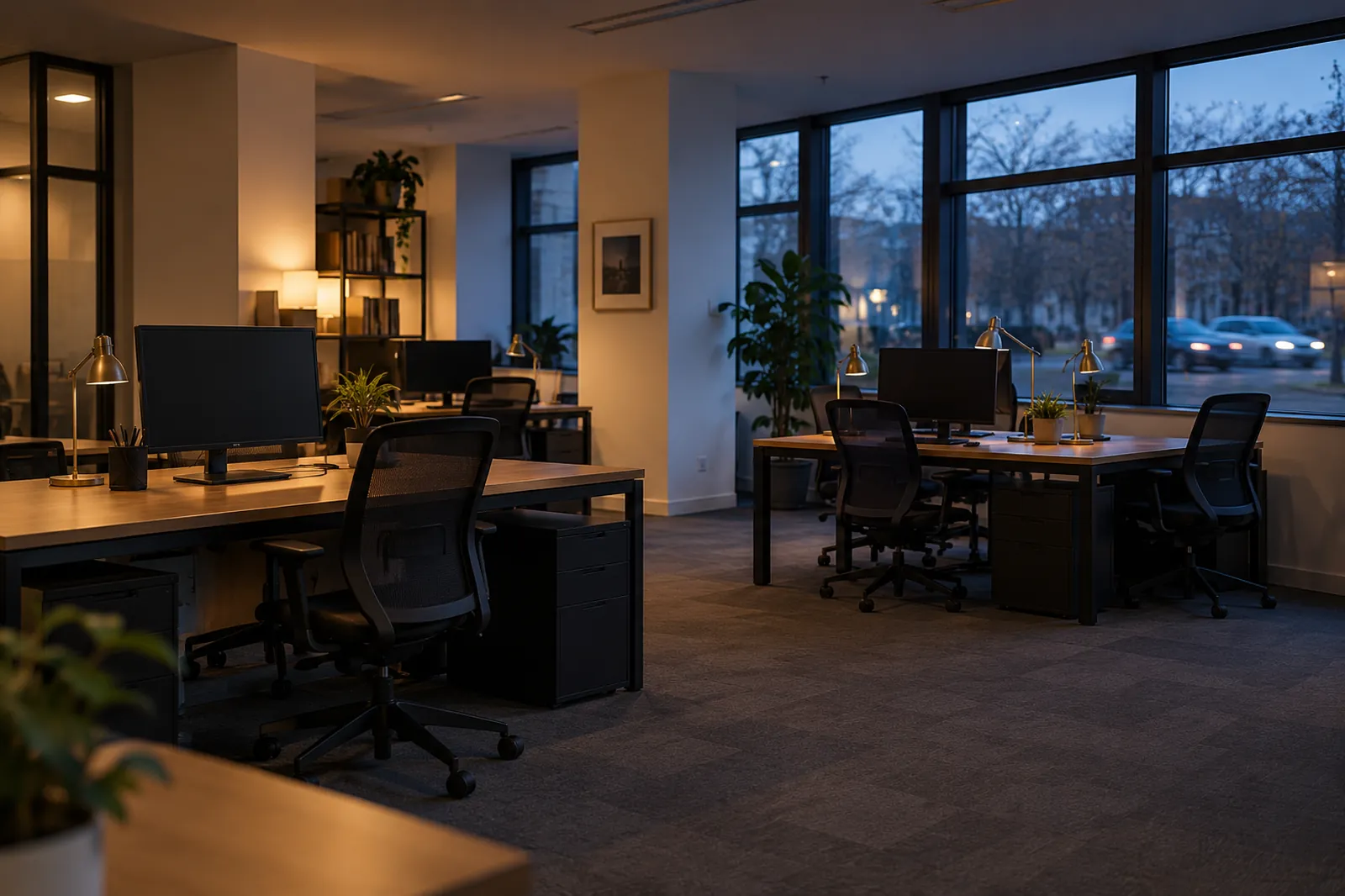
Offices are most of our commercial work, from a studio with three desks to whole floors, and most office cleans start around 6pm or 7pm once the building has emptied. The schedule below is the rota our contracts start from before a site visit adjusts it. The legal and hygiene reasons behind it come from HSE, the UK Health Security Agency (UKHSA) and the Food Standards Agency.
The law sets a standard, not a timetable
Cleanliness is regulation 9 of the Workplace Regulations. Every workplace, with its furniture, furnishings and fittings, has to be kept sufficiently clean. As far as is reasonably practicable, waste mustn’t collect anywhere but in suitable containers. The regulation itself names no frequency. HSE’s approved code of practice explains “sufficiently clean” as cleaning often enough that dirt and refuse don’t build up, with spills cleaned up as soon as possible. The cleaning has to be done by a suitable method that puts nobody at risk, and for the products themselves HSE points to COSHH, the regulations on hazardous substances.
Toilets have their own rule. Regulation 20 says toilets and the rooms they are in must be kept clean and orderly. The code asks for cleaning frequent and thorough enough to do that, and for responsibility to be clearly set, especially where more than one business shares the facilities. Eating areas should be kept clean to a suitable hygiene standard, again with someone clearly responsible. In a shared building it pays to settle this with the landlord or managing agent first: who cleans the shared toilets and kitchens, and how often.
Floors are a safety matter as well. The same code calls slips and trips the most common cause of injury at work, and says most slips happen when floors are wet or contaminated. It asks for routine cleaning arrangements, spills removed promptly, and smooth floors left dry after cleaning or kept clear of people until they are.
An office cleaning schedule, area by area
This is the rota our office contracts usually begin with. The site visit changes it, because two offices with the same headcount can need very different hours.
| Area | How often | What it covers |
|---|---|---|
| Washrooms | Every visit, with a deep clean and descale once a week | Toilets, basins and floors cleaned and sanitised; soap, toilet roll and paper towels restocked |
| Kitchen or tea point | Every visit | Worktops wiped, the dishwasher loaded or emptied, the floor mopped. Unit fronts and appliance outsides weekly, the inside of the fridge monthly |
| Bins and recycling | Every visit | Emptied, so waste only collects in the bins |
| Desks and touch points | Every visit | Clear desks wiped, door handles and lift buttons wiped, meeting rooms put straight |
| Phones and keyboards | Weekly | Wiped down. Staff ask for this more and more |
| Carpets | Walkways every visit, every carpet edge to edge weekly | Vacuumed |
| Glass and high-level dusting | Monthly | Glass partitions and meeting-room walls, skirting boards, cabinet tops, light fittings, vents and door frames |
| Deep clean | Every three months, where the office needs it | Carpets deep cleaned, hard floors stripped and resealed, washroom grout scrubbed |
The carpet lines follow what carpet-tile makers ask for. The maintenance guide from Interface says vacuuming should ideally be daily, with entrance lobbies, corridors and barrier mats needing more, and conference rooms and boardrooms vacuumed at least once a week. It plans deeper cleans by traffic: every three months in heavy-traffic areas, every six in medium and every twelve in light. The mats at the door catch grit before it reaches the carpet, and Interface says they should be cleaned daily.
The rest of the rota moves with how the office is used. A reception that takes deliveries and visitors all day needs its floor and glass done more often than a back office. The site visit is where we work that out with you, room by room.

Touch points matter most when a bug goes round
UKHSA’s workplace guidance says keeping workplaces clean reduces the risk of infection and can reduce sickness in a workforce. It singles out the surfaces people touch a lot. In an office those are door handles, lift buttons, kitchen taps and the shared printer. The same guidance suggests giving staff cleaning products, soap and hot water so they can help keep the workplace clean.
A stomach bug needs more than a wipe. UKHSA says norovirus can survive on surfaces for days or weeks. It recommends a bleach-based solution on contaminated surfaces, typically 0.1% sodium hypochlorite (1,000 parts per million), with disposable gloves where possible. Alcohol hand gels don’t kill norovirus, so hands need soap and warm water. Anyone who has had it should stay off work until 48 hours after their symptoms stop.
Keep bleach away from the washroom limescale remover. UKHSA says bleach mixed with an acid gives off chlorine gas, and limescale removers work because they are acidic, as our limescale guide explains.
The office kitchen needs a named owner
The Food Standards Agency’s advice on chilling food is written for homes, but it fits a shared office fridge well. The fridge should run between 0 and 5°C, checked with a fridge thermometer about once a week, and leftovers should be eaten within two days. Pick a day each week to clear out anything past its use-by date, and put a name against the job, because HSE’s code asks for clear responsibility for cleaning eating areas.
The agency’s cleaning advice says dish cloths, tea towels and sponges should be washed or changed regularly, because dirty, damp cloths encourage bacteria. Keep one cloth for surfaces and another for washing up. It also separates the products. Detergents lift grease but don’t kill bacteria or viruses. Disinfectants do, but only on a surface that is already visibly clean, and only if they are left for the contact time on the label. So a worktop gets cleaned first and disinfected second.
Staff who clean between visits need protecting too
If staff wipe down their own desks or the kitchen, HSE’s COSHH advice for cleaners applies to them as well. It warns that hands kept wet for a long time can develop dermatitis, that some ingredients in cleaning products can cause skin allergies and asthma, and that some products are corrosive. The controls it lists are ordinary ones. Store products safely, work in a way that avoids spills and skin contact, provide gloves where the task needs them, and wash and dry hands properly afterwards.
Having your office cleaned for you
Our commercial cleaning is done out of hours. Offices are usually cleaned in the evening, roughly 6pm to 10pm, or early in the morning between 6am and 9am. A one-off clean is £27 per cleaner per hour. Regular contracts are quoted after we walk round the site, usually within 48 hours of your call, as a fixed price for the rota you agree.
You get the same cleaner or the same small team each visit, with a named backup for holidays and sickness. Every visit is logged with the date, the time, the cleaner and what was done. We can keep the soap, toilet roll and bin liners stocked as part of the contract, and disinfect the office after a sickness bug before staff come back. Where there’s no free parking, we add what parking costs us and nothing more.
Every cleaner sent to an office has been interviewed in person, is insured, and was trained before working alone. The quarterly carpet clean is booked through our carpet cleaning service, and office chairs and reception sofas can be booked in at the same time for upholstery cleaning. If you would rather keep the washroom grout in-house, our grout cleaning guide covers it. After a fit-out or refurbishment, building dust needs more passes and different kit, so that work is an after builders clean at £31 per cleaner per hour for business premises.
Questions we get asked
Is there a legal minimum for how often an office is cleaned?
No. The Workplace Regulations 1992 set a standard: the workplace kept sufficiently clean, waste kept in suitable containers, toilets kept clean and orderly. HSE’s code of practice says the frequency depends on the nature of the business, so it is up to the employer to set a rota that meets that standard.
How often should office toilets be cleaned?
Often enough to keep them clean and orderly, which is the legal test, with one person or firm clearly responsible. On our office contracts the washrooms are cleaned and restocked on every visit, then deep cleaned and descaled once a week.
How often should office carpets be cleaned?
Vacuum the walkways every visit and every carpet edge to edge at least once a week. Interface, which makes carpet tiles, asks for daily vacuuming where possible and no less than weekly in conference rooms and boardrooms. For deep cleaning it plans every three months in heavy-traffic areas, six months in medium and twelve in light. We deep clean the busy parts of an office every quarter where the carpet needs it.
How often should an office be deep cleaned?
On our rotas the high-level dusting and glass come round monthly, and the carpets, hard floors and washroom grout every three months where they need it. On top of that, book a one-off deep clean after a stomach bug has gone round the office, and an after builders clean after any fit-out.
Sources
- legislation.gov.uk, The Workplace (Health, Safety and Welfare) Regulations 1992, regulation 9
- HSE, Workplace health, safety and welfare: Approved Code of Practice and guidance (L24, second edition), 2013
- HSE, COSHH and cleaners: key messages
- GOV.UK (UKHSA), Reducing the spread of respiratory infections, including COVID-19, in the workplace, updated 10 June 2022
- UKHSA, Norovirus: what to do if you catch it and helping to stop the spread, 23 October 2025
- GOV.UK (UKHSA), Sodium hypochlorite: general information, updated 24 April 2025
- GOV.UK (Food Standards Agency), How to chill, freeze and defrost food safely, 25 June 2026
- GOV.UK (Food Standards Agency), Why is cleaning important?, 25 June 2026
- Interface, Carpet tile maintenance guidelines (EMEA), revised 4 December 2021