
Limescale dissolves in a mild acid. Wet the scale with white vinegar or a citric acid solution, give it time to soften, then rinse it off with clean water and dry the surface. The surface underneath decides the details: acid etches marble and other natural stone, several tap makers advise against vinegar on their finishes, and a descaler must never meet bleach.
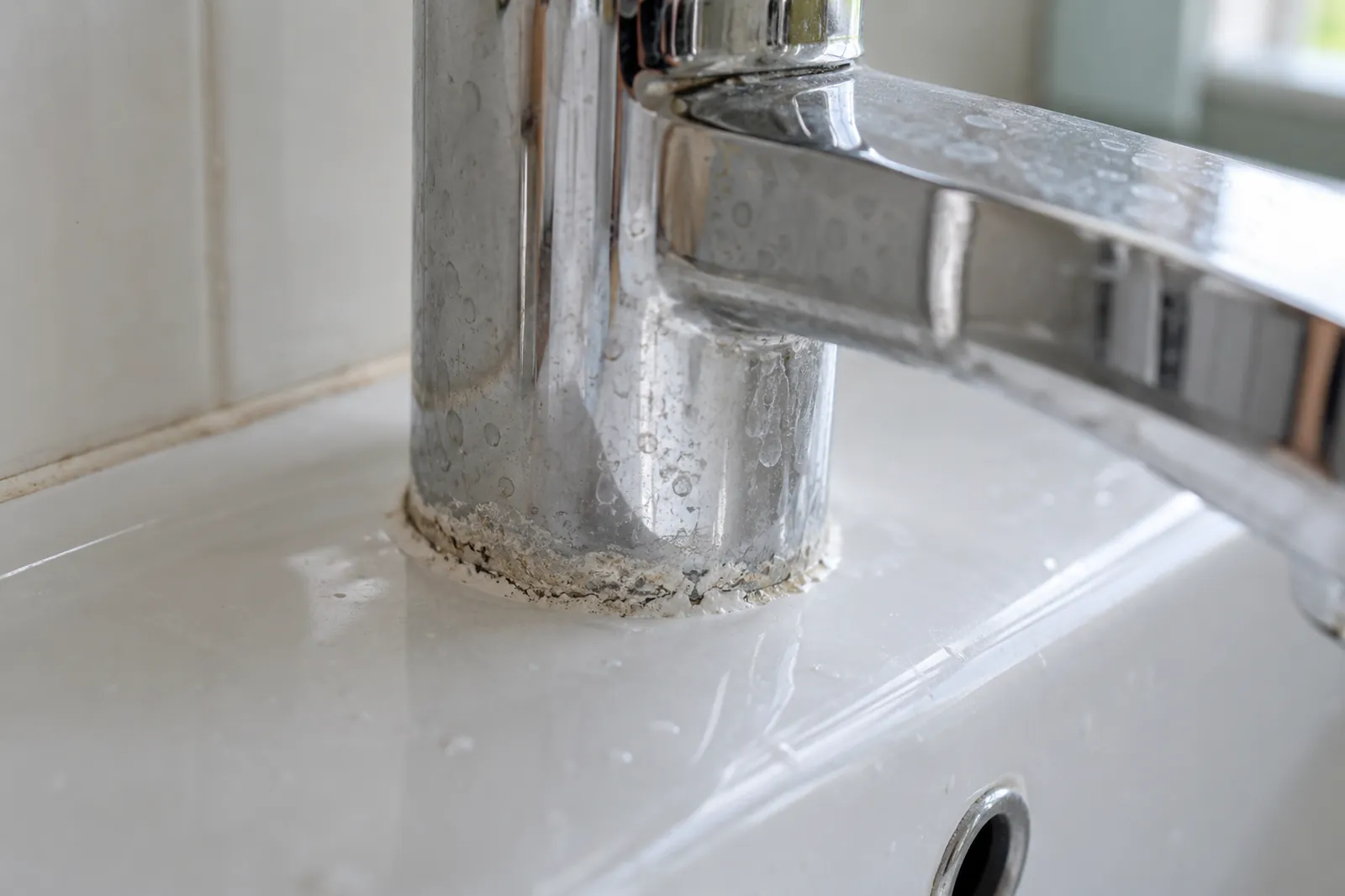
On our regular cleans in London, the sink and taps are descaled on every visit, because the water here is hard enough that they need it weekly. Where the people who make taps, showers and baths disagree with the usual vinegar advice, this guide says so.
London’s tap water is hard
Rainwater is soft. Soaking down through the chalk and limestone under the South East, it picks up calcium and magnesium, the minerals that make water hard (Affinity Water; Drinking Water Inspectorate). Heat that water, or let a drop dry on a tap, and the minerals come back out as a chalky deposit made mainly of calcium carbonate. That deposit is limescale.
Thames Water, which supplies most of London, says all the water in its region is hard. On its scale, hard starts at 200 mg/l of calcium carbonate, the level at which WHO guidance quoted by the DWI says water will produce scale. Affinity Water’s 2025 reports for its north and west London zones run from 268 mg/l in Rayners Lane to 360 mg/l in Harrow North, both single samples. SES Water, to the south, softens its water slightly, so hardness there depends on where you live. For your own figure, use the postcode checker from Thames Water, Affinity Water or SES Water.
Which acid goes on which surface
Alicia Day, a scientific adviser at Which?, says citric acid is slightly stronger than vinegar at dissolving limescale and works well on shower screens and taps. It doesn’t smell of vinegar, either. What matters more is everything else the acid touches.
| Surface | Descale with | Keep off it |
|---|---|---|
| Kettle, inside | Citric acid in a just-boiled kettle, or equal parts white vinegar and water | Bicarbonate of soda, which Which? says is not effective on limescale |
| Chrome tap | Whatever the maker’s care guide says. Hansgrohe recommends a mild citric acid cleaner on a cloth | Vinegar on Hansgrohe and Grohe taps; scourers on any tap |
| Brass, gold, nickel or coloured tap | Warm water and mild soap. Perrin & Rowe allows half lemon juice, half water, for up to an hour | Vinegar, bleach and abrasive cloths |
| Shower head | A citric acid soak, or white vinegar where the maker allows it | Vinegar on a brass head for longer than 30 minutes (Mira) |
| Glass shower screen | Half water, half vinegar (Merlyn), or citric acid, rinsed off | Gritty or abrasive cleaners, which Ideal Standard says destroy the coating |
| Toilet bowl | A bathroom limescale remover, used as the label says | Leaving strong cleaners in overnight; any bleach in the pan |
| Steel enamel bath | Lukewarm water and vinegar mixed 1:1 (Kaldewei) | Neat vinegar, scouring pads and steel wool |
| Cast iron enamel bath | Mild, warm soapy water | Acid-based and lemon products (UKAA) |
| Marble, limestone, travertine, granite | Washing-up liquid diluted in water | Vinegar, lemon juice and any acid descaler |
Natural stone takes the most damage. Marble and limestone are largely calcite, a form of calcium carbonate, so the acid that dissolves limescale dissolves the stone as well (US Geological Survey). Which? warns that vinegar or lemon juice can eat away at granite and marble and dull their shine. Where a tap sits on marble, put the descaler on a cloth first so no spray lands on the stone.
Descaling a tap without damaging the finish
Most limescale guides start with vinegar. Several tap makers tell you not to. Hansgrohe advises against baking soda and cleaners based on vinegar or acetic acid, and says its quality laboratory settled on citric acid. Grohe’s UK care page rules out acid cleaners, limescale removers and household vinegar, and says damage from improper treatment is not covered by its warranty. Even the cloth is disputed: Hansgrohe says no microfibre on its taps, and Perrin & Rowe calls a damp microfibre cloth ideal. So find the maker’s name first. It is often printed on the tap, or in the paperwork that came with it.
- Read the maker’s care advice. If it rules out acid on your finish, use its method and stop there.
- Wash off the soap film with warm water and a few drops of washing-up liquid, as Ideal Standard advises, then rinse and dry the tap.
- Pick the mildest acid the maker allows, such as a citric acid cleaner or Perrin & Rowe’s half lemon juice, half water.
- Soak a soft cotton cloth or a strip of kitchen paper in it and wrap it round the base and the spout, so the acid stays on the scale.
- Leave it for around 15 minutes, the time Which? gives for tougher spots, then wipe the softened scale away with the cloth. If some is left, put on a fresh wrap. Don’t scrub: Hansgrohe says microscopic scratches are enough to tarnish a high-gloss finish.
- Rinse with clean water and dry the tap with a soft cloth to bring the shine back.
The aerator at the end of the spout unscrews on many taps. Hansgrohe soaks it in hot water with a little cleaning agent for about ten minutes.

Soaking a shower head
Rub the nozzles first. Hansgrohe says limescale rubs off soft silicone nozzles with your fingers, and keeps a citric acid cleaner for heavier deposits.
For a soak, Which? dissolves two tablespoons of citric acid powder in roughly a litre of hot water and leaves the head in it for about an hour. A fixed head goes into a zip-lock bag of the solution, held on with an elastic band. Mira, the UK shower maker, uses white distilled vinegar for 30 minutes to an hour, and takes a brass head out at 30 minutes. Hansgrohe advises against acetic acid, the acid in vinegar, and lifts its heads out of a citric bath after a few minutes. Keep the rubber washer safe when you unscrew a hand shower, and run the shower afterwards to flush out loose scale.
A shop descaler is stronger. Mira says to wear gloves and never to spray one overhead, where it can get in your eyes.
Clearing a glass shower screen
A screen stays clear mostly through what happens after each shower. Merlyn, which makes shower enclosures, and Ideal Standard both say to wipe the glass after every use and remove the water left on it. Which? suggests a squeegee or a window vac, and our guide to cleaning windows without streaks covers the squeegee method.
For marks already there, Merlyn suggests half water and half vinegar, rinsed off completely; the experts Which? asked preferred citric acid. Keep the spray on the glass, because Merlyn notes that chrome is vulnerable to acid attack, and use nothing gritty: Ideal Standard says abrasive products destroy the coating on its enclosure glass.
If the glass is still cloudy once it has been descaled, rinsed and dried, the marks may be in the glass itself. More acid won’t shift those, and a scourer only adds scratches. Black along the bottom seal is usually mould, which our guide to black mould on silicone sealant covers.
Descaling a kettle
This is the citric acid method from Which?:
- Half-fill the kettle and boil it, then switch it off and unplug it.
- Add one to two tablespoons of citric acid.
- Leave it for 15 to 20 minutes, then pour the water away.
- Rinse the kettle out a couple of times before you use it again.
With vinegar, Which? boils equal parts white vinegar and water, leaves the kettle to cool completely, then rinses it several times so no taste is left. It suggests descaling every month or so, more often for a glass kettle in a hard water area. Bicarbonate of soda is for grease (our oven door glass guide uses it), and Which? says it is not effective on limescale. Between descales, Thames Water suggests a steel scale collector in the kettle, and SES Water suggests boiling fresh water each time.
Limescale in the toilet
Toilet scale collects under the rim and along the waterline. Ideal Standard allows occasional use of a mild bathroom limescale remover, rinsed away with plenty of water straight after, and says not to leave strong cleaners or bleach in the WC overnight. Keep to the time on the label, brush and flush. If the scale is still there, SES Water says an acidic-type cleaner may be needed.
Never use a descaler in a toilet with bleach still in it. UKHSA’s information on sodium hypochlorite, the chemical in household bleach, says that mixing it with an acid such as vinegar produces chlorine gas. Even the small amounts released when cleaning products are mixed can burn the eyes and throat and cause coughing. If bleach went down the pan earlier, flush it away and descale another day. A toilet gel that lists sodium hypochlorite is a bleach.
Slowing the build-up
In hard water the scale comes back however well it was cleaned, so most of the work is stopping water drying on surfaces. Grohe says drying a fitting each time it is used avoids lime spots, and SES Water says the same of baths and taps. Ideal Standard adds one more: fix a dripping tap.
SES also says a cooler hot water cylinder lays down less scale in the pipework, though it should stay at 60°C because bacteria can grow below that. A jug filter with carbon and ion exchange resin, it adds, makes a kettle less likely to scale. Our cleaning schedule generator puts a 30-minute limescale round into its monthly tasks.
Having it descaled for you
A regular clean is £23 an hour per cleaner weekly or £24 fortnightly, for at least three hours a visit. The cleaner descales the sink, taps, bath, shower and screen each time. A deep clean starts at £186 for two cleaners for three hours (£26 per cleaner per hour, plus £30 for equipment and detergents). The team takes the limescale off the taps, shower heads, glass and tiles, and leaves the descaler long enough to work before anyone scrubs.
Moving out? An end of tenancy clean starts at £156 for a studio and includes the limescale on the taps, shower head, screen and tiles. If the letting agent flags anything within 48 hours, we come back and re-clean it free. Our guide to what London inventory clerks check covers the rest of the bathroom. Where there’s no free parking, we add just what parking costs us.
Questions we get asked
Is citric acid better than vinegar for limescale?
Usually. Alicia Day of Which? says citric acid is slightly stronger at dissolving limescale and smells less, and Hansgrohe calls it its favourite active substance. Vinegar still works well inside a kettle and on fittings whose makers allow it, such as a Kaldewei steel enamel bath with the vinegar diluted half and half. Neither belongs on marble, limestone or granite.
Can you leave limescale remover in the toilet overnight?
Ideal Standard, which makes toilets, says not to leave strong cleaners or bleach in the WC overnight, and to rinse a limescale remover away with plenty of water straight after use. Keep to the contact time on the label and repeat on another day if scale is left. Never pour a descaler into a pan that still has bleach in it.
Is limescale harmful?
Not to your health. SES Water says limescale is not harmful and hard water is completely safe to drink, and Thames Water says the minerals in hard water are not considered harmful. The cost falls on the home. SES says the deposits can affect how appliances look and perform, and hardness reacting with tea leaves an oily-looking film on hot drinks.
Will a water softener get rid of limescale?
It takes out the minerals that form new scale, because many in-line softeners swap the calcium and magnesium in the water for sodium. Scale already on the taps still has to be cleaned off once. SES and Thames Water both say softened water shouldn’t be used for drinking or cooking, so a separate unsoftened tap goes in with it, and SES suggests a WaterSafe-approved plumber for the job.
Sources
- Thames Water, Hard water
- Thames Water, Check your water quality (postcode checker)
- Affinity Water, Check the hardness of your water
- Affinity Water, 2025 water quality reports: Rayners Lane (AF055) and Harrow North (AF056)
- SES Water, Water hardness and limescale, July 2026
- SES Water, Your water quality and hardness report (postcode checker)
- Drinking Water Inspectorate, Water hardness / hard water
- GOV.UK (UKHSA), Sodium hypochlorite: general information, updated 24 April 2025
- Wikipedia, Limescale
- US Geological Survey, The erosion of carbonate stone
- US Geological Survey, How does acid precipitation affect marble and limestone buildings?
- Which?, 8 things you really shouldn’t clean with vinegar, 16 March 2026
- Which?, How to clean your bathroom, 20 January 2026
- Which?, How to descale a kettle, 7 April 2026
- Which?, How to descale a shower head, 26 August 2026
- Which?, Things you should never clean with bicarbonate of soda, 11 June 2026
- Hansgrohe UK, Cleaning recommendations for taps
- Hansgrohe UK, Descaling your shower head
- Grohe UK, Brassware care
- Perrin & Rowe, Care and maintenance: brassware finishes, 2026
- Mira Showers, How to clean and descale your shower head, updated 19 May 2026
- Merlyn, What is the best way to clean my Merlyn products?
- Ideal Standard UK, Maintenance FAQ
- Kaldewei, Warranty and care instructions, steel enamel (GB), 2026
- UK Architectural Antiques, Caring for cast iron enamel baths