
Dirty grout on a tile floor usually comes clean with an alkaline grout cleaner, given time to work. Vacuum first, work the cleaner into the lines at the strength the label gives and leave it for 5 to 15 minutes, keeping it wet. Scrub each line with a stiff nylon brush, pick up the dirty water and rinse with clean water until no cleaner is left. Keep vinegar and other acids off cement grout and natural stone, and never mix a bleach-based mould spray with another cleaner.
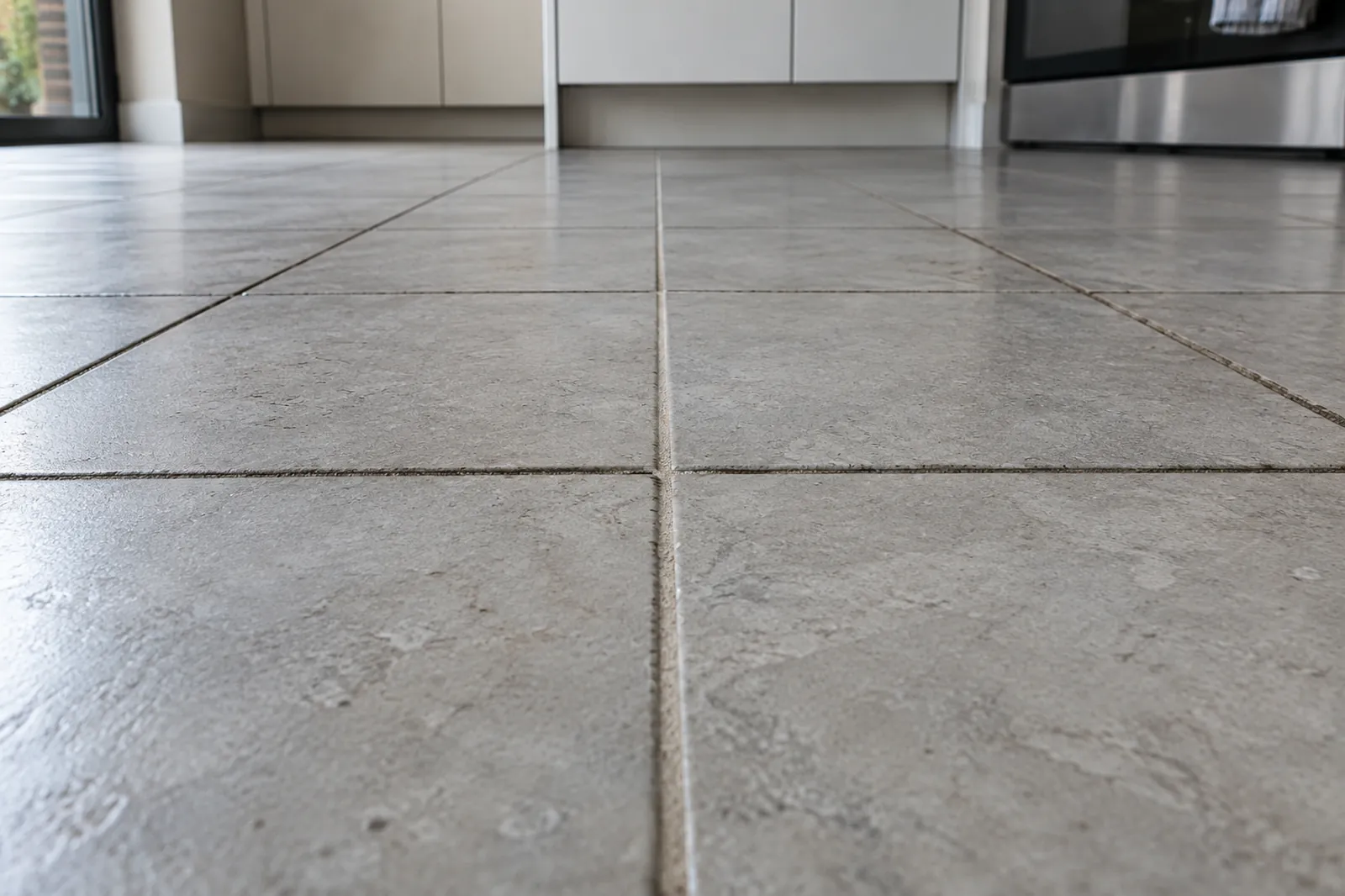
On our hard-floor cleans, tile and grout get an alkaline grout cleaner left for about ten minutes, a rotary brush along every line, then extraction so the dirty water comes up off the floor. The method below is the hand version of the same job, with the dilutions and times taken from the people who make grout cleaners.
Grout soaks up dirt
Cement grout is porous. LTP, which makes tile cleaners and sealers in Somerset, says its grout protector helps protect porous wall and floor grout joints from water, dirt, oil, grease and limescale. Each time a floor is mopped, the grout soaks up a little of the mop water and whatever is in it. That is why a kitchen floor mopped every week can still have grout lines far darker than the day they went down.
In kitchens, Lithofin says grease splashes and cooking vapour get into the grout, and the oil and grease harden with time and get harder to remove. HG adds dirt carried in on shoes, cleaning products that leave a residue which attracts more dirt, mould where a room stays damp, and limescale.
Choosing a grout cleaner
The cleaner has to suit two materials at once: the grout, and the tile or stone on either side of it.
| Cleaner | Use it on | Keep it off |
|---|---|---|
| pH-neutral cleaner | Regular mopping, sealed grout, epoxy grout and natural stone floors. LTP recommends a mild pH-neutral detergent for grout treated with its protector | Stubborn, ground-in dirt, where LTP says a stronger cleaner may be needed |
| Alkaline grout cleaner (about pH 12) | Grease and ground-in dirt in cement grout between ceramic and porcelain tiles | Polished marble and other alkali-sensitive surfaces (Lithofin), and bare skin: LTP asks for gloves and eye protection |
| Acid cleaner (grout haze or limescale remover, vinegar) | Cement residue, limescale and efflorescence on ceramics, slate, quarry tiles and acid-resistant stone (LTP) | Marble, travertine, limestone, engineered stone, chrome and enamel (LTP). Keep contact with the grout short: LTP says to avoid prolonged contact with grout joints |
| Mould and mildew spray | Black mould in shower and wall grout | Any other cleaner in the same session. If it contains bleach, mixing it with an acid gives off chlorine gas (UKHSA) |
Natural stone needs the most care. Kärcher’s check for an unknown stone is a few drops of acid on a hidden spot: if it foams, the stone is sensitive to acid and must not be treated with acidic cleaners. Marble and limestone are largely calcite, which acid dissolves (US Geological Survey). On a marble, limestone or travertine floor, the grout gets the same pH-neutral cleaner as the stone, and our limescale guide lists the other surfaces acid damages.
Epoxy grout is the easy case. Mapei describes its epoxy grout as non-absorbent, acid-resistant and easy to clean, so a neutral clean is usually all it needs.
Cleaning floor grout, step by step
- Move what you can and vacuum the floor, grout lines included. Wet cleaning over loose grit rubs it into the surface like sandpaper.
- Open a window and put on gloves and eye protection. The data sheet for LTP’s heavy-duty grime remover, an alkaline cleaner, asks for both.
- Try the cleaner on a hidden patch, such as behind a door, and let it dry before you judge it.
- Dilute it as the label says. LTP gives 1 part to 10 parts warm water for mild dirt and 1 part to 3 for severe dirt, and HG’s grout concentrate goes 1 part to 4 of lukewarm water. Lithofin’s grout cleaner goes on a damp sponge straight from the bottle, a dash at a time.
- Spread it along the lines of a small area and leave it to work without letting it dry. LTP gives 5 to 10 minutes for severe dirt, topped up with more solution to keep it wet, and Lithofin gives 10 to 15 minutes.
- Scrub each line lengthways with a stiff, narrow nylon brush.
- Pick up the dirty water with a mop or a wet-and-dry vacuum before it can dry back into the grout. Then rinse with clean water, changing it as it gets dirty, until no cleaner is left. LTP says any alkaline cleaner left on the surface should be neutralised with clean water, and Lithofin says always wash well with water.
- Let the floor dry, look at the grout in daylight and go over any line that is still dark.
LTP says its grime remover is not for everyday cleaning of sealed floors, so keep it for the occasional deep clean and mop with a neutral cleaner in between.
Steam loosens light dirt with no cleaner at all. Kärcher runs the floor nozzle of its steam cleaner over the joints in a cross pattern, up and down and then side to side. HG directs the steam onto the grout and brushes where needed. Wipe the floor afterwards, because the loosened dirt is still sitting on it.

Grout in the shower
HG treats the marks left on bathroom grout after a clean as limescale or mould, with a different product for each. For mould, the government’s damp and mould guidance says mould and mildew products should be used in preference to bleach. Whoever removes the mould should wear a mask, gloves and goggles, with the door shut and the window open. For limescale, Kärcher wets the tile joints with water before an acid cleaner goes on, so the joints are not attacked, and gives it about five minutes.
Use one product at a time. UKHSA’s information on sodium hypochlorite, the chemical in household bleach, says mixing it with an acid such as vinegar produces chlorine gas. Plenty of mould sprays are bleach-based, so if the label lists sodium hypochlorite, treat the spray as bleach and rinse it off completely before anything else goes on.
Black in the silicone along the bath or shower tray is a separate job, covered in our guide to black mould on silicone sealant. For the sprays and grout pens worth buying, see our round-up of the best grout cleaners.
Vinegar, bicarbonate and other home remedies
Vinegar is the one to be careful with. HG, which makes grout cleaners, says the acidity in vinegar can weaken, discolour and damage grout, especially with repeated use, and that cement-based grout is more at risk than other types. If you use it, HG’s advice is half vinegar and half water, only now and then, rinsed off after a few minutes. It never goes on marble or limestone.
Bicarbonate of soda and vinegar cancel each other out. Which? says the two neutralise each other, and the fizz is carbon dioxide being released. HG lists a paste of hydrogen peroxide and bicarbonate of soda among the home alternatives, with the warning that home remedies give less consistent results than a grout cleaner.
Grout that won’t come clean
If a line is still dark once it is clean and dry, the colour is in the grout itself. Grout stained by mould or dye may not go all the way back to its first colour. A grout pen covers what is left, and grout that is cracked or crumbling needs a tiler to rake it out and regrout.
Sealing slows the next round of dirt. LTP’s directions are to clean older, dirty grout with its grime remover, rinse it thoroughly, then apply the protector. A floor can take foot traffic after a 2 to 3 hour cure, and a shower or wet room needs at least 24 hours before it is used. Its check is a little water on the treated grout: if the water soaks in, the joint needs a second or even a third coat. Where a sealed floor has been deep-cleaned with the grime remover, LTP says to reseal it once it has been rinsed and has dried for at least 24 hours.
Having your floor grout cleaned for you
Our hard-floor cleaning is £6 per m², or £8 per m² with a polish, so a 15 m² kitchen floor comes to £90 cleaned. Floor jobs start at £67. On tile, the cleaner puts down an alkaline grout cleaner, leaves it for about ten minutes, runs a rotary brush along every line, then extracts the water so the dirt leaves the floor. Grout that has been grey for years often comes back close to its first colour. Where the property has no free parking, we add what parking costs us.
Moving out of a rented home? An end of tenancy clean washes hard floors as standard, and dark grout that needs more than a mop can go on the same booking as a floor clean.
Questions we get asked
What is the best thing to clean grout with?
For dirty cement grout between ceramic or porcelain tiles, an alkaline grout cleaner, left for 5 to 15 minutes and scrubbed with a stiff brush. Lithofin’s is about pH 12. A pH-neutral cleaner is the one for regular mopping, sealed grout, epoxy grout and natural stone. Acid cleaners are for cement haze and limescale, and LTP, which makes one, says to avoid prolonged contact with grout joints.
What should you not clean grout with?
Regular vinegar or other acids on cement grout, which HG says can weaken and discolour it. No acid at all on marble or limestone, and no strong alkaline cleaner on polished marble (Lithofin). Never put a bleach-based spray on grout that still has a limescale remover or vinegar on it, because UKHSA says bleach and acid together give off chlorine gas.
How can I get grout white again?
Clean it first, because most darkened grout improves a great deal with a proper clean. Black mould on white wall grout comes off with a mould and mildew spray, following the same government mould guidance. White grout that is still grey once it is clean and dry has been stained, and a grout pen is the cheap way to cover it.
Should you seal grout after cleaning?
Cement grout benefits from it. LTP’s protector forms a colourless barrier against water, dirt, oil, grease and limescale, and goes on once the grout has been cleaned and rinsed. Epoxy grout doesn’t need it: Mapei describes its epoxy grout as non-absorbent, so there is nothing for a sealer to soak into.
Sources
- LTP, Grimex heavy duty grime remover: technical data sheet, 2025
- LTP, Grout stain remover: technical data sheet, 2025
- LTP, Grout and tile protector: technical data sheet, 2024
- Lithofin UK, KF Grout Cleaner and its technical information (GB)
- HG, How do I clean the grout on my tile floor?
- HG, Can vinegar damage grout?
- HG, Grout cleaner concentrate
- Mapei UK, Kerapoxy Easy Design epoxy grout
- Kärcher UK, Cleaning tiles
- GOV.UK, Understanding and addressing the health risks of damp and mould in the home, updated 1 April 2026
- GOV.UK (UKHSA), Sodium hypochlorite: general information, updated 24 April 2025
- Which?, Things you should never clean with bicarbonate of soda, 11 June 2026
- US Geological Survey, The erosion of carbonate stone
- US Geological Survey, How does acid precipitation affect marble and limestone buildings?