
Most patios come clean with warm water, a squirt of washing-up liquid and a stiff brush. Sweep off the leaves and grit, scrub a small area at a time and rinse with clean water. If you use a pressure washer, keep it on a low setting with the lance at a shallow angle, and put back any jointing sand it washes out. Keep acids off limestone and sandstone: vinegar, brick acid and many patio cleaners can dissolve limestone and stain some sandstones orange. Black spots are lichen, which scrubbing and jet washing barely touch, so they need a treatment of their own.
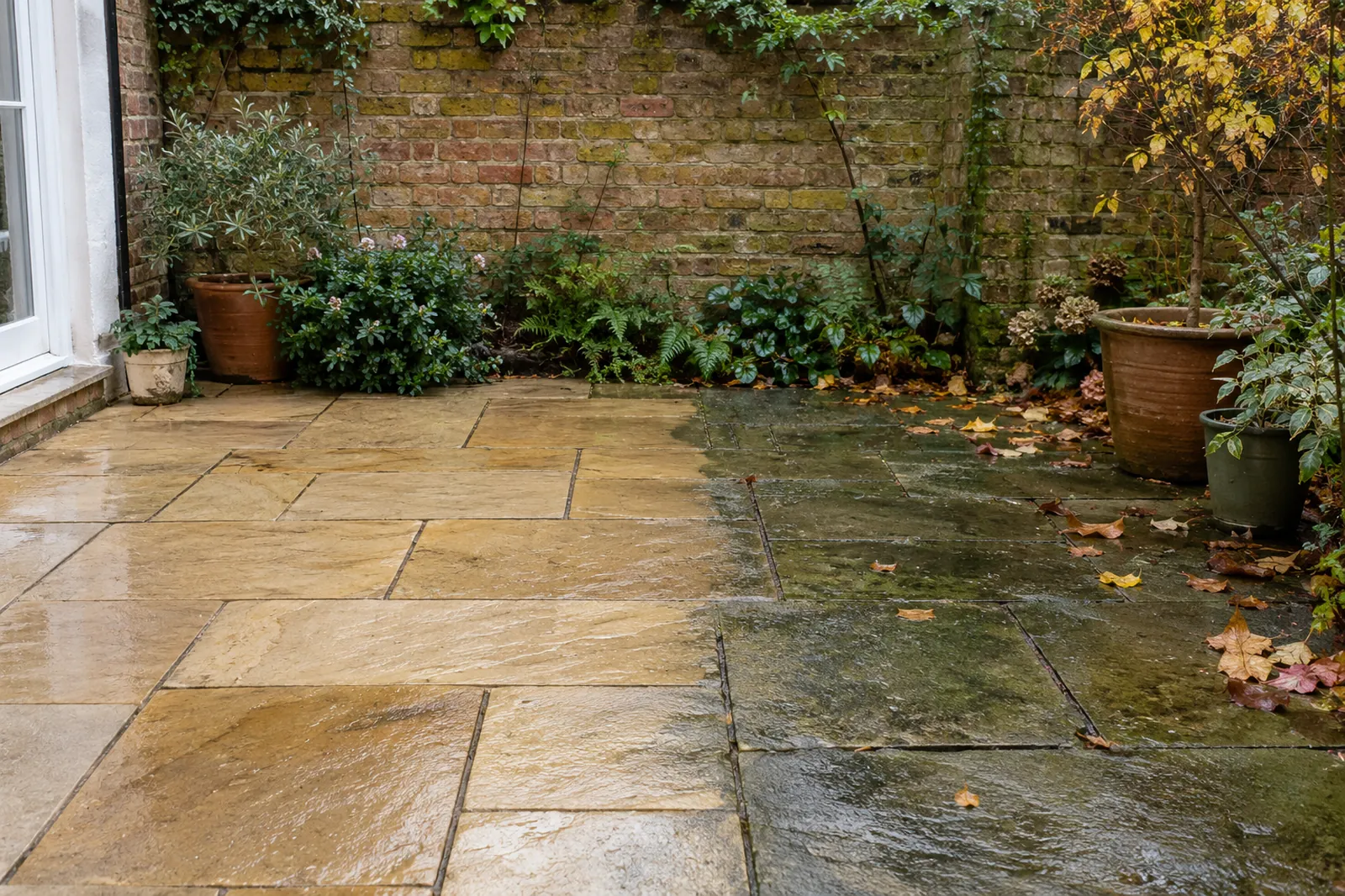
On our pressure-washing jobs, moss, algae and lichen get a biocide before the wash. The pressure is set for the surface in front of the cleaner, and a rotary surface cleaner does the open areas so the finish has no stripes. Block paving gets fresh kiln-dried sand in its joints at the end. The method below is the version you can do at home, with the limits taken from the companies that make the slabs.
Start with what the patio is made of
The slab decides the method. An acid that shifts cement stains can turn some sandstone orange, and pressure that suits granite can mark softer stone for good.
| Surface | Wash it with | Keep off it |
|---|---|---|
| Porcelain | A brush and clean water. Marshalls says stains tend to sit on the surface, so many come off with a damp cloth and a little mild detergent. Bradstone says porcelain doesn’t need sealing | Jet washing it for the sake of it: Bradstone says to avoid needless pressure washing to protect the joints |
| Concrete slabs | Warm soapy water and a stiff brush. Concrete is absorbent, so deal with spills before they soak in (Bradstone) | High-pressure washing, which Bradstone says wears the surface and removes jointing over time. Marshalls says its wet-cast slabs are less resistant to chemical cleaners |
| Block paving | Washing-up liquid in warm water, scrubbed diagonally so less sand comes out of the joints (Bradstone) | A jet held close, which lifts the jointing sand. Refill the joints with kiln-dried sand once the paving is dry |
| Sandstone, including Indian sandstone | By hand or at low pressure (Marshalls, Kärcher) | Acid. Marshalls says some sandstones turn orange with acid cleaners, and that many patio cleaners and brick acids are hydrochloric acid based |
| Limestone | By hand, with warm soapy water | Any acid: Marshalls says hydrochloric acid dissolves limestone and marble. No common salt to de-ice it either (Marshalls) |
| Granite, basalt and slate | Kärcher says very hard stone such as granite and basalt can take high pressure | Acid until you have tested it. Marshalls says most granites and slates are unaffected by acid cleaners but must be tested first; Bradstone doesn’t recommend acid on granite or slate at all |
Cleaning a patio by hand, step by step
- Move the furniture and pots, then sweep. Kärcher suggests a straw or plastic broom for the leaves and twigs, because a metal rake can damage the surface.
- Scrape the moss and weeds out of the joints with a joint scraper or an old knife, which is what the RHS suggests for moss between paving.
- Wet the slabs in small sections. Bradstone starts this way because it loosens the surface dirt and stops dust spreading while you work.
- Half-fill a bucket with warm water and add a squirt of washing-up liquid. Marshalls’ technical guide gives a hot detergent solution, made with washing-up liquid or non-bio washing powder, for general dirt and algae.
- Scrub hard with a stiff yard brush, one way and then across. On block paving, Bradstone scrubs diagonally, which is gentler on the jointing sand.
- Rinse with clean water from a hose or a bucket, and keep the run-off out of flower beds and ponds. Marshalls asks owners not to let cleaning water contaminate the turf, beds or ponds next to the paving.
- Let the patio dry completely before you judge it. Paving can look darker when it is wet, and on a cool day Marshalls says the drying may take overnight.
- Go over any patch that is still dirty a second time. Bradstone repeats the gentle wash before it reaches for anything stronger.
For a lot of patios, that is the whole job. Marshalls says power washing with high-pressure equipment is not normally required. Bradstone goes further and doesn’t recommend pressure washers on its patio slabs at all, because regular or high-pressure washing can damage the surface and wash out the jointing.
Pressure washing without marking the stone
If you do use one, the precautions in Marshalls’ aftercare guide and technical guide are the ones to follow:
- Sweep first. Loose grit hit by the jet acts as an abrasive.
- Try a hidden corner before the whole patio.
- Keep the machine on a low setting (the technical guide says no more than medium pressure) and don’t use an oscillating lance.
- Never point the lance straight down. Hold it at a shallow angle, about 30 degrees and at least 200 mm from the surface, or use a rotary scrubbing attachment.
- Check the joints when you finish. Refill sand joints, and have mortar joints re-pointed where the wash has opened them up.
The nozzle is where most of the damage starts. Held in one spot for a few seconds, it can mark sandstone for good. A hand lance that lingers in patches leaves the light and dark stripes you see on some freshly washed drives. Kärcher, which makes pressure washers, keeps high pressure for very hard stone and says softer natural stone should get low pressure or be cleaned by hand. Its surface cleaner attachments let you set the nozzles further from the slab for a gentler clean.
Plug the machine into a socket with RCD (residual current device) protection, or into a plug-in RCD if your fuse box doesn’t have one. That is Electrical Safety First’s advice for outdoor equipment, along with safety glasses for the spray that bounces back.
Block paving needs its sand back before cars go on it. Marshalls says the sand is what binds the blocks together. Bradstone’s re-sanding method starts once the paving is completely dry. Spread kiln-dried sand over it and sweep it into the joints with a soft broom. Walk over a small area, or compact a large one, then top up and sweep off the surplus. Pick a dry day, because damp sand clumps and won’t fill the joints.

Green growth comes back where the patio stays damp
Algae, moss and lichen don’t damage paving, according to the RHS, but they make it slippery, which is the reason to clear them where people walk. Algae thrive in wet conditions and grow faster in shade with poor air circulation, and the RHS says build-ups often follow wet winters. On our jobs, north-facing patios and anything under trees go green fastest.
Autumn adds leaves. Marshalls says leaves contain tannins that can stain a patio or driveway, so sweep them up regularly while they are falling, before they get trodden in.
For heavy growth, Marshalls’ cleaning guidelines say paving treatments take some days to work and do best in a spell of dry weather. Scrape off the thick growth first and brush the wash well in; the dead growth then weathers away. The RHS takes a lighter line. It says brushing and better drainage work, so there is no need for mosskillers or chemical patio cleaners, and that growth returns if the spot stays damp and shady. Its fixes are pruning overhanging plants so sun and wind can dry the paving, and making sure the surface sheds water into drains kept clear of leaves.
Black spots are lichen
Pavingexpert, the long-running UK paving site that Marshalls credits in its own cleaning guide, says the black (sometimes white) spots are almost always lichen. Part of each lichen is a fungus that sends fine threads down into the stone, which is why brushing, scrubbing and even power washing have little effect on them. Imported sandstone suits lichen best. Granite and basalt resist it far better, because their structure is crystalline.
Lichen has to be killed where it grows, and that takes time. On our jobs the spots get a specialist biocide, left for about 48 hours before the wash. Most cases clear fully, though very old, deep-set spots can leave faint shadows. Pavingexpert warns that wire brushes, wire wool and abrasive powders are far more likely to damage the paving than to remove the lichen.
Products to keep off the patio
- Vinegar and other acids on limestone or marble, which acid dissolves. BBC Gardeners’ World notes that vinegar is corrosive and can damage plants as well. Keep acid off sandstone too: Pavingexpert says some imported sandstones react to cleaning acids with rust staining that often can’t be reversed, and that many products sold as patio cleaners contain acid. Our limescale guide covers the indoor surfaces acid damages.
- Neat bleach. Pavingexpert says to dilute it and never use it neat, and Marshalls calls bleach corrosive and says it can kill plants, grass and wildlife if it runs off the paving. Never use it alongside vinegar or an acid cleaner: UKHSA says bleach mixed with an acid gives off chlorine gas.
- Weed and moss killers that contain ferrous sulphate, which Marshalls says can leave a brown stain on the paving.
- Common salt to de-ice limestone or reconstituted stone. Bradstone clears snow and ice with a stiff brush or a plastic shovel.
- Cleaning chemicals tipped down an outside drain. The Environment Agency warns that many drains are part of a surface water system, so what goes down them can end up in a local river.
Having your patio pressure washed for you
Our pressure washing is £4 per m², so a 20 m² patio comes to £80 and a 30 m² driveway for one car to £120. Jobs start at £67, which only affects areas under 17 m². The price covers the biocide, the detergents, the machines and the kiln-dried sand for block paving. Concrete, block paving and hard stone take full pressure, while sandstone, softer stone and timber get far less, with the biocide doing most of the work. We need a working outside tap and a standard socket. After the wash, the surface wants 24 to 48 hours of dry weather to settle, so we try not to book a job for the day before heavy rain is forecast. Where there is no free parking near the property, we add what parking costs us.
Washing often shows up crumbling mortar between slabs. We don’t re-point, but we tell you what needs doing. If the windows above the patio want doing too, our guide to cleaning windows without streaks covers the glass. Cement splashes and mortar drops left by builders are far easier to shift in the first month than after a winter of rain. For the inside of the house, see our guide to cleaning up after builders.
Questions we get asked
What is the best thing to clean a patio with?
For most patios, warm water with washing-up liquid and a stiff yard brush, then a rinse with clean water. Marshalls also suggests non-bio washing powder in hot water for dirt and algae. Bradstone’s advice is to start with the gentlest method and repeat it before moving to anything stronger. Black spots are the exception, because they are lichen and need a treatment made for it.
Can I use bleach on my patio?
Some slab makers do suggest it. Bradstone uses diluted bleach on algae and lichen on block paving, and Marshalls adds a few tablespoons to a bucket of soapy water for a very dirty patio. Both treat it as a harsh chemical: wear gloves, test a corner, rinse it off thoroughly and keep it away from plants, ponds and drains. Never use it with vinegar or an acid cleaner, because the mix gives off chlorine gas.
Why are there still black spots after jet washing?
They are lichen, which grows down into the stone. Pavingexpert says brushing, scrubbing and power washing have little effect. The spots need a biocide left on long enough to kill them. We leave ours about 48 hours before washing, and very old spots can still leave faint shadows.
How often should a patio be cleaned?
Sweep it every week or two, as Bradstone suggests, and more often while the leaves are coming down. Kärcher says patio slabs need a thorough clean at least twice a year. A pressure wash every 12 to 24 months suits most of the patios and driveways we clean. North-facing ones and anything under trees can need it every year, and a south-facing patio in a dry spot can go three years.
Sources
- Marshalls, Patio and driveway aftercare guide, 2022
- Marshalls, Technical information: maintenance and power-washing, 2021
- Marshalls, Cleaning and maintenance guidelines: gardens and driveways
- Marshalls, How to clean your patio slabs, updated 14 April 2025
- Marshalls, How to pressure wash your patio, decking or driveway, updated 14 January 2026
- Marshalls, Outdoor porcelain tiles 101, updated 21 February 2025
- Bradstone, How to clean your patio slabs: a step-by-step guide, 14 June 2024
- Bradstone, How to clean block paving, 3 February 2025
- Bradstone, How to re-sand block paving, 14 March 2025
- Kärcher UK, How to clean patio slabs
- RHS, Algae, lichens, liverworts and mosses on hard surfaces
- Pavingexpert, Dealing with lichens
- Electrical Safety First, Electrical safety advice for pressure washers
- BBC Gardeners’ World, How to clean a patio, updated 29 January 2026
- GOV.UK (UKHSA), Sodium hypochlorite: general information, updated 24 April 2025
- GOV.UK (Environment Agency), Warning after nearly 200 fish deaths on the Devon river, 26 March 2014