
Clear the rubble, open the windows, then vacuum the dust from the ceiling down with a vacuum that has a HEPA filter, before any cloth gets wet. Don’t sweep it: the Health and Safety Executive (HSE) says dry brushing throws fine dust into the air, where it settles again later and the floor has to be cleaned twice. Once the air has cleared, wipe every surface with a damp microfibre cloth, mop the floors with a pH-neutral cleaner and go round again once the last of the dust has landed. In a home built or refurbished before 2000, get advice first if the work broke into anything that might contain asbestos.
On our after builders cleans, the cleaners use HEPA vacuums and always work in the same order. They air the place out, vacuum from the top down, lift the paint and plaster spots, do the wet clean, then walk round once more. The method below follows that order for doing it yourself. The health points come from HSE’s guidance on construction dust, which is written for building firms.
Builders’ dust is finer than house dust
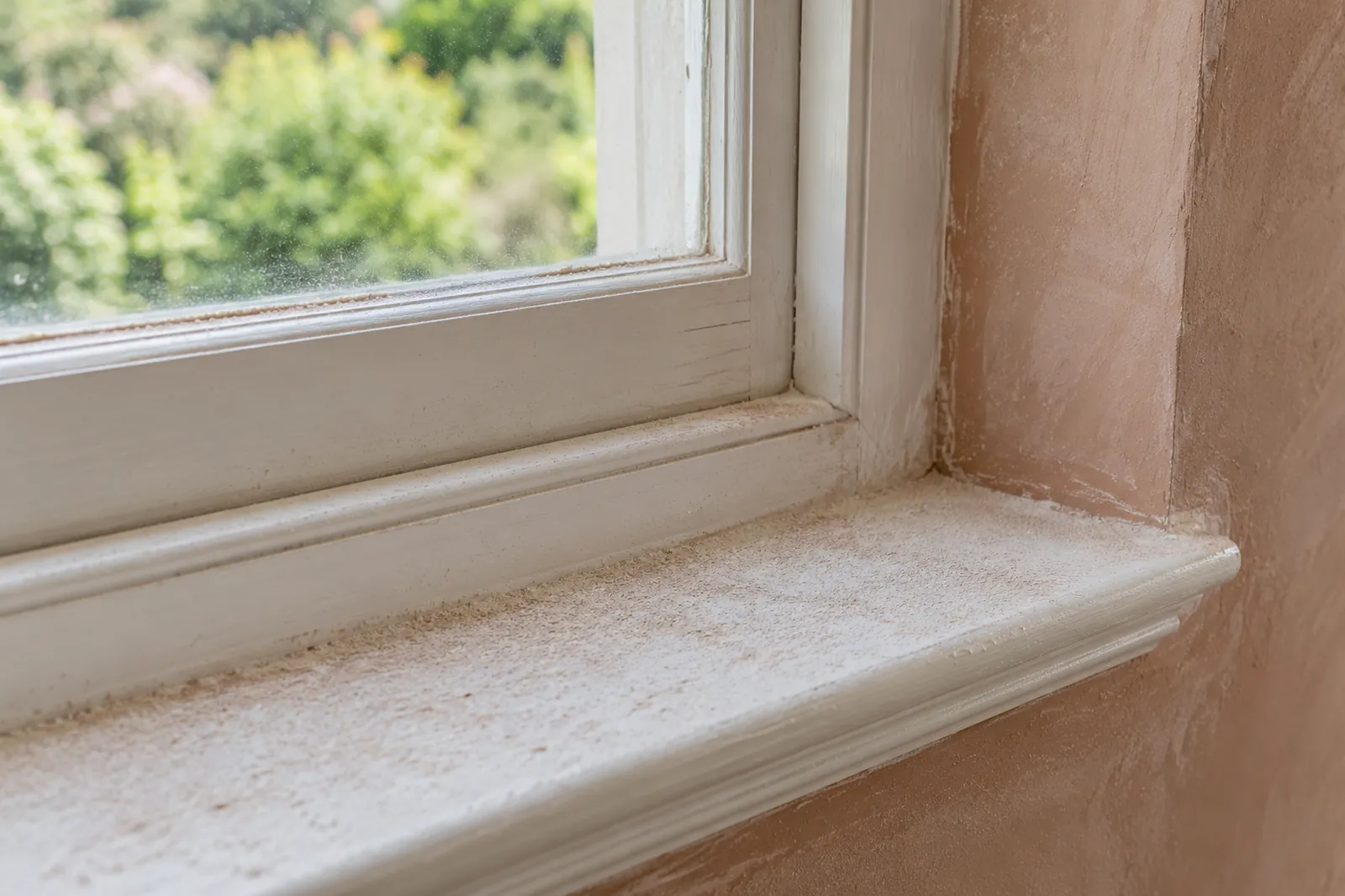
Plaster and MDF dust are far finer than household dust. They hang in the air for hours once anything in the room moves. Vacuum a sill, make a cup of tea, and there is a new film on it by the time you come back. The same dust gets into places nobody checks: shut cupboards, the top edges of doors, the gap behind each radiator, the extractor fins and the trickle vents on double glazing.
HSE splits construction dust into three main types. Silica dust comes from cutting, drilling and grinding materials such as concrete, mortar and sandstone. Wood dust includes MDF and chipboard. The third group has little or no silica in it, and the commonest are gypsum (the material in plasterboard), cement, limestone and marble.
Is the public at risk? HSE’s answer is that the lung diseases it links to construction dust come from breathing it regularly over a long period, not on the odd occasion. It adds that even a short spell can cause a reaction in someone who already has asthma or another breathing problem. If someone at home does, keep them out of the rooms while the dust is being moved.

In older homes, check for asbestos and lead paint first
HSE’s asbestos FAQs say it may be part of any building built or refurbished before 2000. In homes it turns up in textured ceiling coatings such as Artex, pipe and boiler lagging, insulating board that looks very like plasterboard, floor tiles, water tanks and toilet cisterns. If the work broke into anything like that and you don’t know what it was, leave the debris alone. HSE’s advice to householders is not to repair or remove suspected asbestos without training, to ask the environmental health officer at the council, and to tell any builder about it before work starts. Asbestos waste is hazardous waste and can’t go in the household bin.
Old paint is the other thing to think about. The British Coatings Federation says lead was taken out of most paints in the 1960s, and that many wood or metal surfaces painted before then could contain high levels of it. If old doors, skirting or sash windows were sanded or stripped, keep children and pregnant women away until the clean-up is done. The federation’s advice is to wash every surface in and around the work area, vacuum with a HEPA-filtered vacuum, and seal the debris, masks and filters in plastic bags with tape.
A HEPA vacuum does most of the work
Most household vacuums blow fine plaster dust straight back out through the filter. That’s why our cleaners use HEPA vacuums on every after builders job. Building firms are held to a tougher standard. For clearing up dust, HSE’s construction dust sheet names vacuum attachments on an H or M class extraction unit, and tells firms not to rely on a general commercial vacuum. Whatever you use, empty it outside and change or clean the filter as its maker says.
Wear a mask for bagging rubble or vacuuming heavy dust. HSE’s guidance on clearing up tells building firms to use one such as an FFP3 disposable, depending on where the work is, how long it takes and what is in the dust. A tight-fitting mask only protects you if it seals against your face.
Cleaning up builders’ dust, step by step
- Get the offcuts, packaging and loose rubble out first. For small amounts, HSE damps the debris down and uses a brush, shovel and bucket.
- Open the windows and trickle vents and wedge the internal doors before a cloth touches anything. Moving air carries a lot of the hanging dust outside.
- Don’t dry-sweep. HSE’s page on dry sweeping says brushing can push large amounts of dust into the air, which re-settles later so the floor has to be cleaned again.
- Vacuum from the top down: cornicing, picture rails, light fittings, the top edges of doors, shelves, sills, radiators and the gap behind them, then the skirting. Gravity helps that way, and anything that falls lands on a surface you haven’t done yet.
- Do the insides. Every cupboard and drawer, including the drawer runners, where MDF dust collects more than anywhere, plus the air vents, extractor grilles and window trickle vents.
- Leave the room for a while with the windows open, then wipe every surface with a damp microfibre cloth, rinsing it often. Don’t dry-wipe dusty glass: the cleaning leaflet from glass maker Glas Trösch says dusty and gritty deposits must never be removed dry, and starts by spraying the glass liberally with water.
- Do the floors last. Vacuum again, grout lines included, then mop with a pH-neutral cleaner. Karndean, which makes vinyl flooring, says loose grit causes fine scratches and steers owners away from household cleaners and bleach-based detergents.
- Walk round again later in a different light. Late-afternoon sun shows up dust and grout haze that the morning light hid.
Paint, plaster and cement on new surfaces
Residue is a separate job from dust, and it is where new finishes get damaged. The wrong cloth scratches, and one pass of an abrasive scourer over matt emulsion polishes a shiny patch into it that shows under every downlight until the wall is repainted.
- Paint splashes. Valspar says almost all household paint is now water-based, and wet emulsion comes off with warm soapy water and a cloth. Dried flecks are harder, so deal with them early: paint on new aluminium frames is far harder to move once it has had a fortnight to dry.
- Plaster, cement or mortar on glass needs rinsing off with plenty of water straight away. Glas Trösch says these are highly alkaline and turn glass dull if they are left on it.
- Silicone smears on self-cleaning glass. Pilkington says sealant should come off its Activ glass before it dries, and that abrasive materials must not be used on what has cured.
- New uPVC frames. Anglian rules out cream cleaners, bleach, white spirit, WD-40, scouring pads, nail varnish remover and methylated spirits, which can scratch the frames or take off their gloss. Anglian wipes frames and sills with a sponge and warm soapy water.
- Grout haze and cement on new tiles take an acid-based remover. LTP’s data sheet for its grout stain remover keeps it off marble, travertine, limestone, engineered stone, sandstone, chrome and enamel. Wear gloves and eye protection, keep its contact with the grout joints short and rinse thoroughly with clean cold water. Our grout cleaning guide covers which cleaner suits which tile.
Jobs to hand back to the builder
Skips, rubble and building materials need clearing before any proper clean, because nobody can clean round a stack of plasterboard in the hallway. The waste is your responsibility as well as the builder’s. Bromley Council reminds householders of their legal duty of care. Check that whoever takes it away is a registered waste carrier, on the Environment Agency’s public register, and get a waste transfer note. If illegally dumped waste is traced back to your home, the council says you can be fined up to £5,000.
Defects go back to the builder too, on the snagging list, and they are much easier to spot on a clean surface.
Having it cleaned for you
Our after builders cleaning is £30 per cleaner per hour, plus £32 for equipment and detergents. One cleaner for four hours comes to £152, and two cleaners for four hours each to £272. A one-bed flat after a tidy kitchen refit is often four to five hours with one cleaner, and a four-bed house after a full renovation is a day’s work for two cleaners, sometimes more. The cleaners arrive with HEPA vacuums, pH-neutral floor solution, residue removers, microfibre cloths and ladders. Where there’s no free parking, we add just what parking costs us.
Plaster dust also works down into carpet pile, deeper than a vacuum reaches, and carpet cleaning can go on the same visit. New builds often have cement run-off on the outside glass as well. Once it is off, our guide to cleaning windows without streaks covers the glass.
Questions we get asked
Is plaster dust dangerous?
For most people at home, HSE’s answer is no. The lung diseases it links to construction dust come from breathing it regularly over a long period, although even a short spell can set off someone with asthma. It puts gypsum, the material in plasterboard, among the dusts with little or no silica. Silica dust, from concrete, mortar and sandstone, is a different matter: HSE estimates it may be responsible for over 500 deaths a year among people who have worked in construction.
How long does dust take to settle after building work?
Longer than most people expect. HSE says fine dust can stay suspended in the air for a long time, and on our jobs plaster dust is still landing hours after anything in the room has moved. Vacuum first, leave the room with the windows open, do the wet wipe, then go over the flat surfaces again.
Should the clean happen before the snagging inspection?
Yes. Book the clean first. Scratches, gaps in the caulk, uneven grout and missed paint all hide under dust, so the snagging list you hand the developer after a clean is far more complete.
Sources
- HSE, Dust: frequently asked questions (construction), updated 11 March 2026
- HSE, Construction dust: dry sweeping, updated 12 November 2024
- HSE, Construction dust (Construction Information Sheet 36, revision 3), March 2020
- HSE, Asbestos: frequently asked questions, updated 4 September 2025
- British Coatings Federation, Lead in painted surfaces: guide for the general public (HS032), December 2015
- Glas Trösch, Technical leaflet: glass cleaning, October 2026
- Karndean UK, Cleaning and care
- Valspar UK, How to get paint out of different surfaces, updated 23 January 2023
- Pilkington, Self-cleaning glass: general FAQs
- Anglian, How to clean uPVC windows
- LTP, Grout stain remover: technical data sheet, 2025
- London Borough of Bromley, Your waste is your responsibility
- Environment Agency, Public register of waste carriers, brokers and dealers