
To clean windows without streaks, wait for a dry, overcast day and brush the dust off the frame and sill first. Wash the glass with lukewarm water and a small squirt of washing-up liquid, pull the water off with a rubber squeegee from the top down, then dry the edges and the sill with a microfibre cloth. Most streaks come from the sun drying the glass before you can wipe it, or from too much detergent in the bucket.
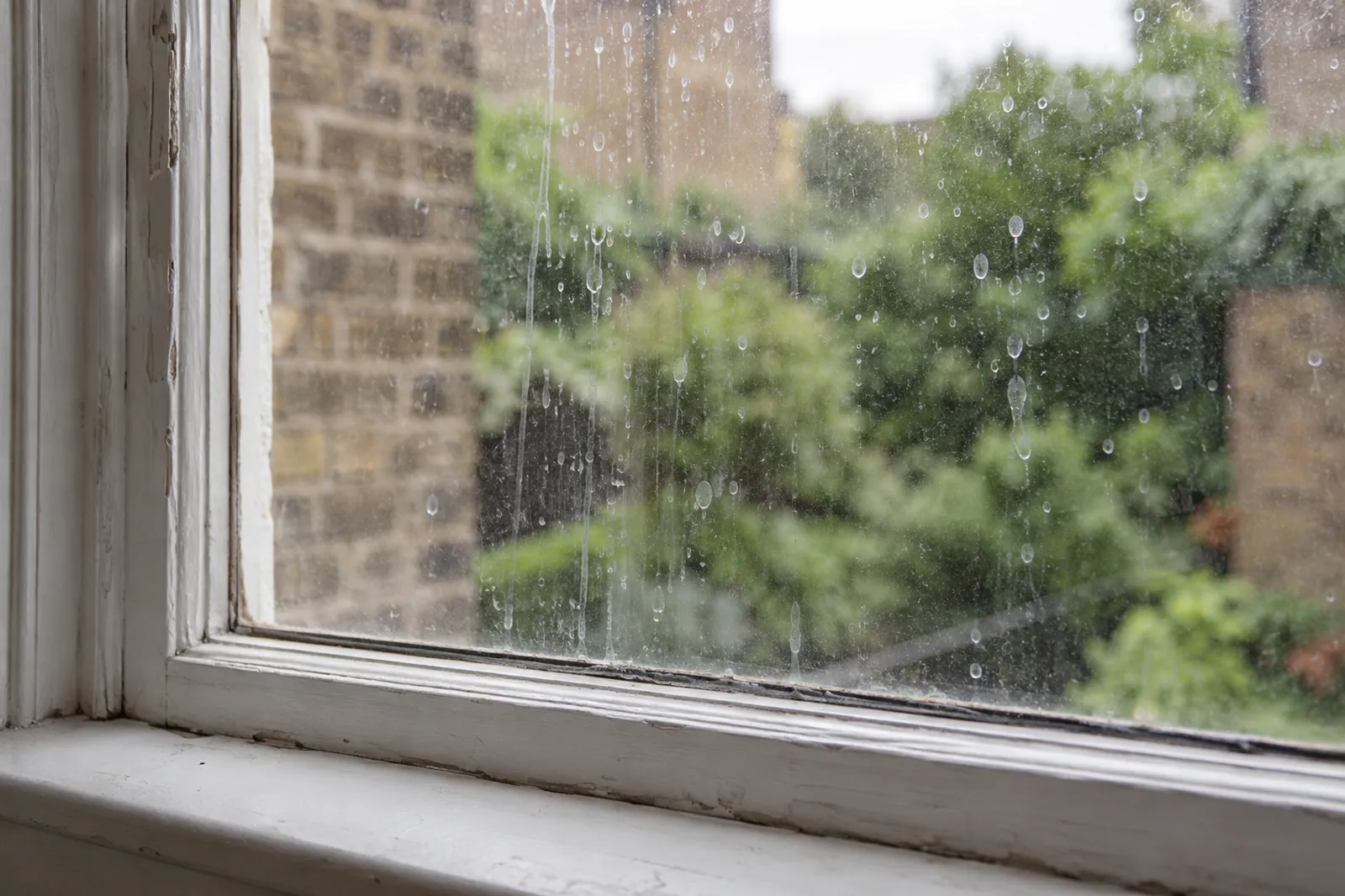
On our window cleans, ground-floor glass is done this way, by hand with a squeegee and cloth. Anything higher is cleaned from the ground with a pure-water pole. The method below follows the care advice of the companies that make the squeegees, the windows and the glass.
The usual causes of streaks
A streak is whatever the water leaves behind as it dries: detergent, minerals from the tap, or dirt that ran down from the frame. Each cause has its own fix.
| Cause | What you see | The fix |
|---|---|---|
| Sun on the glass | Smears of cleaning product that dried before you reached them | Clean on a dull day, or on the side of the house the sun has left. Kärcher says never to clean windows with the sun on them or on hot days |
| Too much washing-up liquid | A greasy film over the pane | One small squirt in a bucket of lukewarm water. Kärcher suggests a washing-up liquid without balsam |
| Hard tap water left to dry | White, milky marks | Take every drop off with the squeegee and cloth. Pilkington links milky-white streaks to hosing glass with hard water |
| A worn or nicked squeegee rubber | Streaks that come back on every pass | Change the rubber. Unger replaces it after 15 hours of use, or sooner if it has a nick |
| Uneven pressure on the squeegee | Bands of water left on the glass | Hold the blade at about 45 degrees and let the squeegee’s own weight do the pressing (Unger) |
| A dirty frame | Grey runs down the clean glass | Brush and wipe the frame before the glass gets wet (Unger, Kärcher) |
Cleaning the outside glass, step by step
You need a bucket, washing-up liquid, a sponge or a microfibre applicator, a squeegee with a rubber blade and two dry microfibre cloths. If you are buying, our round-up of the best window cleaning products compares squeegees and window vacs.
- Pick a dry, overcast day. Anglian, the window company, says a cloudy day stops streaks of cleaning product drying on the glass.
- Brush the cobwebs and loose grit off the frame and sill with a hand brush or a dry cloth. Then wash the frame with plenty of warm soapy water and wipe it dry with a soft cloth, which is what Anglian’s care guide asks for on its PVC-U frames.
- Add a small squirt of washing-up liquid to a bucket of lukewarm water. Kärcher warns that too much leaves a greasy film on the glass.
- Wet the whole pane with the sponge or applicator, and work at bird droppings and other dried-on marks until they soften.
- Start in a top corner with the blade at about 45 degrees to the glass. Unger, which makes squeegees, works down the pane in one continuous S shape, turning the squeegee at each edge without lifting it off the glass. Kärcher describes the same idea as figure-of-eight strokes from the top to the bottom.
- Wipe the rubber on a dry cloth whenever water builds up on it.
- Run a dry microfibre cloth round the edges of the pane to catch the last of the water, then dry the sill.
A squeegee is slow on small panes. On a sash split into a dozen of them, a damp microfibre cloth followed by a dry one is quicker, pane by pane.

Cleaning windows on the inside
Inside glass is usually less dirty, and there is more round it to protect: curtains, a painted sill, a radiator, a wooden window board. Use less water. Anglian’s care guide says to put glass cleaner on the cloth, so that little of it reaches the PVC-U frame.
A damp microfibre cloth and then a dry one will clear most inside glass. Kärcher washes with a wet microfibre or lint-free cotton cloth and dries with a clean microfibre cloth or a squeegee. A window vac does the same job with fewer drips, and it is handy on condensation. Which? sprays the glass, leaves the solution for a minute or two, then slides the vac straight down the pane in strokes that overlap slightly, and empties the tank before it reaches the fill line.
Black specks in the rubber seal round the glass are mould, and glass cleaner won’t move them. Our guide to black mould on window seals and sealant covers that clean, and the condensation that causes it.
Upstairs windows: work from inside or from the ground
Don’t lean out of an upstairs window to reach the outside of the glass. Anglian’s care guide warns about the risk of falling from an open window while cleaning, and many windows are made so that you don’t have to. Anglian’s standard casement hinges open far enough to clean the outside of the pane from indoors. Its PVC-U vertical sliding sash windows tilt inwards for cleaning once the bottom sash is raised at least 75mm (3 inches) off the sill and the catches are slid towards the centre. Other makers’ windows work differently, so check the guide that came with yours.
Many professional window cleaners have swapped ladders for water-fed poles. The safety guidance the Federation of Window Cleaners wrote with the HSE says so, and puts the reach of a pole at windows up to 24 metres (80ft) high from ground level. HSE guidance for window cleaning businesses says to avoid work at height where reasonably practicable, by using telescopic water-fed poles or cleaning from the inside. It also notes that almost all falls from ladders happen because the ladder moves unexpectedly. On our visits, every window above the ground floor is cleaned from the ground with a pole, so nothing leans on your walls.
The pure water window cleaners use
A water-fed pole works with purified water, which the FWC guidance calls an integral part of the cleaning process. Mains water goes through filters until nothing is left dissolved in it. Unger, which makes the filters, says reverse osmosis removes 85 to 95 per cent of the impurities and a deionising filter takes out the rest. It counts water as pure only when its total dissolved solids reading is 0 ppm. With nothing in it to leave behind, the water dries clear, and Unger says it cuts out the wiping and polishing.
Tap water works the other way. Thames Water, which supplies most of London, says all the water in its region is hard and can leave a chalky residue called limescale (our limescale guide has the local hardness figures). Pilkington’s technical tips trace milky-white streaks on windows to hosing them with hard water, and suggest not hosing glass at the hottest time of day. At home, the answer is to leave no tap water on the pane to dry.
Products to keep off your windows
- Scouring pads and cream cleaners. Anglian says scouring pads can scratch both the glass and uPVC, and puts cream cleaners on its list of products to avoid.
- Bleach, white spirit, methylated spirits, nail varnish remover or WD-40 on a PVC-U frame. Anglian’s care guide rules all of them out, along with acids, alkalis, brick wash and high-pressure or steam cleaners.
- Vinegar near a stone sill. Kärcher says to cover a marble sill before a vinegar solution goes on the glass above it. Marble is largely calcite, and acid dissolves it (US Geological Survey).
- Blades and abrasives on self-cleaning glass. Pilkington rules out abrasive materials on its Activ self-cleaning glass, and its technical tips rule out a knife on stuck-on marks. Even on ordinary glass, Unger warns that a scraper dragged backwards with the blade open can mark or scratch it.
Having your windows cleaned for you
Our window cleaning is priced by the size of the house, from £66 for the outside of a one-bedroom house or £101 inside and out. Frames, sills and trickle vents are wiped on every visit. For outside only you don’t need to be home, as long as there is a way round to the back and a water tap. If the street has no free parking, we pass on what parking costs us and nothing more.
Some inventory reports ask for the outside windows to be cleaned at check-out. If yours does, add them when you book your end of tenancy clean.
Questions we get asked
Is vinegar or washing-up liquid better for windows?
Both work, and the makers’ recipes vary. Kärcher uses lukewarm water with a squirt of washing-up liquid, and Anglian’s website suggests 1 tablespoon of white vinegar in 2 litres of water as a polish after washing. Vinegar is an acid, so keep it off stone sills, and off PVC-U frames, where Anglian’s care guide rules out acids. Whichever you choose, use very little: Kärcher says too much cleaning agent leaves a greasy film.
How often should windows be cleaned?
Kärcher suggests inside and out about every two months. We suggest every six to twelve weeks for most homes, and every four to six weeks for a house on a main road or under mature trees. Traffic film builds up faster there, and from April into June the plane trees drop pollen and sticky sap. Anglian’s guide asks for its windows and doors to be cleaned at least once every three to six months.
How do you clean self-cleaning glass?
Mostly the weather does it. Pilkington says its Activ coating needs both daylight and rain to work, and that warm water with washing-up liquid can be used when the glass does need a clean. Abrasive materials must not be used. Where the water is very hard (above 180 ppm), its technical tips suggest a couple of drops of washing-up liquid per litre of rinsing water, or a water softener.
Sources
- Kärcher UK, Cleaning windows: tips for a streak-free view
- Anglian Home Improvements, How to clean uPVC windows
- Anglian, Caring for your Anglian products: operating, cleaning and maintenance guide (ITS402/2, published by Havering Council)
- Unger, Squeegee window cleaning: how to for a streak-free shine, 12 July 2022
- Unger, Streak-free cleaning with pure water, 8 March 2021
- Pilkington, Self-cleaning glass: general FAQs
- Pilkington, Pilkington Activ technical tips (1439, February 2015)
- Which?, Best window vacs, 6 October 2026
- Health and Safety Executive, Working at height whilst window cleaning
- Federation of Window Cleaners with HSE, Safety in window cleaning using water-fed pole systems, amended 31 March 2026
- Thames Water, Hard water
- US Geological Survey, The erosion of carbonate stone
- US Geological Survey, How does acid precipitation affect marble and limestone buildings?