


In a North Springfield bathroom the clerk goes for the base of the mixer tap first, where Essex water sets a chalky collar that a cloth will not shift. That collar costs more deposits round here than anything except the oven. So this is what end-of-tenancy cleaning in Springfield, Chelmsford is built for: the person holding the check-in report, at £30 per hour per cleaner, run against a 57-point agent-approved checklist, with a 48-hour re-clean guarantee measured on the check-out report itself. Ring 0333 555 2076 for a price in about three minutes.
Last updated July 2026. We cover Springfield across CM1 and CM2: the Springfield Road terraces, the conservation area around Springfield Green, the 1970s streets of North Springfield off Lawn Lane, the Arbour Lane and Pump Lane semis, and the newer housing out on the north-east edge. This page sits inside the county directory at End of Tenancy Cleaning Essex.
Which Springfield you mean, and why it changes the clean
There is more than one Springfield and people book the wrong clean because of it. Say the name to a Chelmsford letting agent and they will ask you which bit. That is not pedantry. The stock is genuinely different from one end to the other, and a clerk marks each end against a different check-in report.
The confusion has a paper trail. Springfield was its own village, in the Domesday Book of 1086 as Springafelda, and it stayed a separate parish until Chelmsford started eating it. In 1907 a large part of the south-west of the parish went into the municipal borough, including the old village around Springfield Green and the suburbs then growing along Springfield Road. Another 425 acres followed in 1934. In 2023 the civil parish was cut again, with two new parishes, Chelmer and Chelmsford Garden, carved out of what was left, so the Springfield parish on the map today mostly covers the North Springfield housing estate. The everyday Springfield, the one you mean when you tell us where the flat is, still runs across CM1 and CM2 and takes in all of it.
We mean the everyday one. Here is what it contains, and what each part does to a checkout.
The Springfield Road spine and the old village
Running out of the city towards the prison, Springfield Road carries the older terraced and semi-detached stock, and a lot of it is let. Behind it sits Springfield Green, a conservation area with listed buildings around All Saints’ Church, whose oldest parts date from around 1100. Period joinery is the thing here. Deep skirtings, picture rails, moulded architraves, the tops of door frames. Dust settles in all of it and a torch finds it in two seconds. HM Prison Chelmsford has been on this road since the 1820s, which is a landmark nobody puts in the brochure but everybody uses for directions.
North Springfield, Lawn Lane and the interwar streets
This is the volume rental market and the reason this page exists. North Springfield is a big estate, much of it built in the 1970s, family semis with tiled bathrooms and kitchens of roughly that vintage or one refit later. Around it sit the interwar and post-war semis off Arbour Lane and Pump Lane. These homes are not delicate. They are hard-used, they have taken forty or fifty years of Essex water, and they fail checkouts on scale and grease rather than on anything fancy.
The north-east edge, and the bit that is not built yet
North-east of here, on the Boreham side, Countryside and L&Q have been building Beaulieu through their Countryside Zest joint venture, around 3,600 homes with 176 acres of open space, plus Channels next to it. Beaulieu Park station opened on 26 October 2025, the first new station on the Great Eastern Main Line in a century, putting Liverpool Street roughly forty minutes away and pulling a fresh wave of commuter tenants into this side of Chelmsford. Note that most of that new build now sits in the Chelmsford Garden parish rather than Springfield proper, whatever the listing says. We clean it either way. Down at the other end, Chelmer Waterside on the old gasworks is still groundworks: Bow Bridge Road has opened, the council’s timetable had the gas pressure reduction system relocation finishing in August 2026, and there is no rental market there yet. I would rather tell you that than pretend we have been cleaning flats that do not exist.
How a report written on day one decides the money on your last
Start with the mechanism, because almost nobody does. On the day you moved in, a clerk walked the property and wrote a report describing every surface, usually with photographs, usually with the word “clean” or “as new” against the kitchen and the bathroom. Those words were true that morning, because the place had just been done professionally. At checkout a clerk walks it again and compares the report line by line. Anything materially worse than the check-in entry, past fair wear and tear, is chargeable against your deposit.
Read that last sentence again, because the whole argument turns on it. You are being marked against a professional clean. A mop and a free Sunday were never going to reach that bar, and the clerk is not being unfair by saying so.
The wear-and-tear line is where tenants lose money they should have kept. Carpet worn thin in a doorway after four years is wear. A scuffed skirting board is wear. Scale welded onto a shower screen is not wear, it is a cleaning failure. Grease baked onto the tiles behind a hob is not wear. Each of those gets written up and costed, and each is fixable before the clerk ever sees it.
You are being marked against a professional clean.
The Tenant Fees Act 2019 means no Chelmsford landlord can write professional cleaning into your agreement as a condition, so nobody can force you to book us. The benchmark does not care who does the work. It cares whether the property matches the report. Where we find something that is genuinely the landlord’s problem, damp in a cold corner rather than mould off a seal, we photograph it so the charge lands where it belongs.
Over the years that work has helped tenants recover £1.2m in deposits that would otherwise have gone on cleaning deductions. That number is really the whole job.
Essex water, and the collar round the tap
Get one local fact right and you will understand most Springfield checkouts. Chelmsford is supplied by Essex & Suffolk Water, not by the company most people guess, and the water is hard. Essex & Suffolk also blend supplies from more than one source to keep up with demand, which is why the hardness in a given street can shift a little over the years while never once becoming soft.

Hard water is not trivia here. It is the single most common reason a Springfield bathroom loses money. Calcium builds a chalky crust on taps, around the base of a mixer spout, across a shower screen, along the waterline of the loo and into the grout. In a 1970s North Springfield bathroom that has had fifty years of it, that crust is a grey-white layer a sponge slides straight over. The clerk knows where to look. They run a thumbnail down the tap. They look at the screen edge-on against the light.
We treat it with a proper descaler and real dwell time, not a wipe and a hope. Screens, chrome, tile joints and the loo all come back to what the report recorded. It takes as long as it takes, which is why we ask on the phone which bathroom has been worst rather than find out on the day with the van already loaded. Limescale is slow work. Booking it as fast work is how a clean fails.
A sponge slides straight over it. That is the problem.
The licence question, and Chelmsford’s unusual answer
Tenants moving out from a London borough almost always assume there is a landlord licence involved. In Chelmsford there usually is not. Chelmsford City Council states plainly that it does not have additional or selective licensing schemes in place, so an ordinary Springfield family let needs no licence at all. That is unusual enough in 2026 to be worth saying out loud.
What the council does enforce is mandatory HMO licensing. Where five or more people from two or more households live in a property and share or lack a bathroom, a toilet or cooking facilities, that house needs a licence, and the licence runs for five years. Some of the larger houses along the Springfield Road corridor are let this way, room by room, to people who are not one family.
A licensed HMO checkout is not one tenancy ending. It is a property the landlord has to keep lettable under a licence, with a shared kitchen and a shared bathroom that several unrelated people used and nobody owned. Clerks work the communal parts to a harder line than a family home, because the licence and the speed of the re-let both hang on them. We plan those jobs around the shared kitchen, the shared bathroom and the common stairs from the start, instead of getting to them once the bedrooms are done and the day is gone.
What 1 May 2026 changed for Chelmsford move-outs
The Renters’ Rights Act 2025 went live on 1 May 2026. Section 21 no-fault evictions are gone. Every existing assured shorthold tenancy in England has converted to a periodic tenancy, and a tenant can give two months’ notice at any point in the year rather than waiting out a fixed term.
Here is the part people get wrong. The cleaning side of a move-out did not change at all.
The Tenant Fees Act still applies. The check-in benchmark still applies. The deposit maths is exactly what it was the week before. What changed is timing, and timing is what bites in a commuter suburb like this one, where the rental churn was already heavy and the fixed end date at least gave you something to plan a deep clean around. Now the notice can land in any week of the year. Checkouts arrive at shorter notice and cluster less predictably, so the slot you assumed would be free often is not. Book earlier than you used to. Dull advice, but it pays for itself.
The 57 things we go through, room by room
Every Springfield booking runs to a 57-point agent-approved checklist, built over a decade of local checkouts and ordered the way deductions actually arrive. The full list comes with the job. Here is the shape of it.
The kitchen, where the money goes first
The oven gets a deep clean, not a wipe. Racks and trays come out and soak separately, the brown film on the door glass is worked off by hand, between the panels where the design allows, and the interior, fan, element and seals all get done. Hob rings and burners come off, control knobs off and washed. The extractor hood is degreased inside and out and the filter soaked or replaced. Every cupboard, inside and out, including the awkward deep corners the 1970s North Springfield kitchens are full of. Appliances pulled out so the gaps behind and under them are done, then put back where they were. The washing machine drum, the detergent drawer and the door seal, which is the first thing a lot of clerks open. Sink, taps, drainer and plughole descaled. Tiles and grout scrubbed rather than wiped. Floor last, edges included.
Bathrooms, the room this postcode fails on
Scale comes off the taps, the shower head, the screen and the tiles first, because everything else in the room is quick by comparison. Grout is scrubbed back as far as honest effort goes, and photographed first where it is clearly past saving, so nobody bills you for a state that was already in the check-in pictures. Then the rest, in plain order.
- Toilet done properly: inside, under the rim, the base, the cistern, the hinges, and behind the pedestal
- Shower screen both sides, tracks and the sealant bead included
- Bath, taps, the underside of the taps, the overflow and the plughole
- Mirrors and cabinets, and behind them where they come off the wall
- Extractor vent wiped and the sealant cleaned to a usable state, because re-sealing is a handyman job and not a cleaning one
- Floor into the corners, behind the loo, under the basin pedestal
Bedrooms, living rooms and everything between
Inside every wardrobe, drawer and built-in cupboard. Skirtings, door frames, doors, handles. Light fittings, shades, switches. In the older Springfield Road houses that means the picture rails, the cornices and the tops of the frames, the places you cannot see from standing height and a clerk checks with a torch. Window sills, reveals and frames on the inside. Radiators behind, under and on top. Walls spot-wiped, with a realistic line drawn, since nail holes are a decorator’s bill and not yours to scrub. Hard floors washed with the right product for the material. Carpets vacuumed thoroughly, edges included, where grit and pet hair pack in hardest. Then a walk-through, photographed before and after, every room. That photo set is your evidence if the checkout tries to deduct.
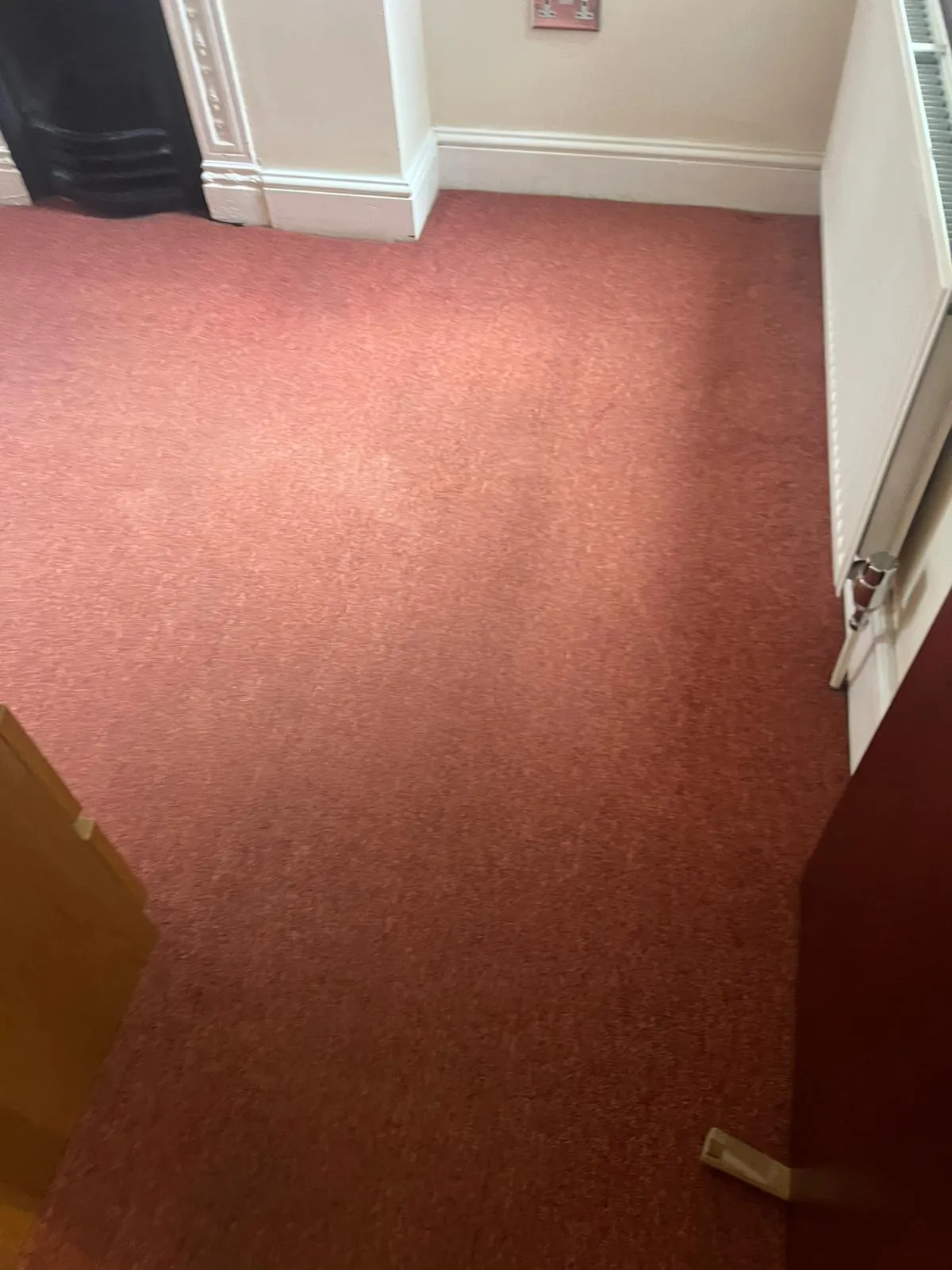
Carpet shampoo is a separate add-on. On a pet property it is usually the sensible spend, and I will say so on the phone.
What it costs, and the sum nobody runs in time
Flat pricing, given before we start. A studio is £156. A one-bed is £207. A two-bed is £243, which covers most of the Springfield Road flats and the smaller Arbour Lane places. A three-bed is £339, and that is the North Springfield semi most of this suburb actually lives in. A four-bed is £425. If you would rather pay by the hour, for a part job or something odd, it is £30 per cleaner. Carpet shampoo runs £29 a bedroom, £36 a living room, or £94 for two bedrooms and a living room. If the oven is the only thing your agent flagged, that stands alone at £77 for a single, £110 for a double and £143 for a 90cm range.
Springfield is not a premium postcode and we do not price it as one. Same figures as the rest of standard Chelmsford.
| Property | Typical duration | Estimated cost |
|---|---|---|
| Studio (Springfield Road conversion or flat) | 3-4 hours, 1 cleaner | From £156 |
| 1-bed flat | 4-5 hours, 2 cleaners | From £207 |
| 2-bed flat or terrace | 5-7 hours, 2 cleaners | From £243 |
| 3-bed semi (North Springfield, Lawn Lane, Arbour Lane) | 6-8 hours, 2 cleaners | From £339 |
| 4-bed house (Beaulieu side, Springfield Park) | 8-10 hours, 2-3 cleaners | From £425 |
| Carpet shampoo add-on | Same visit | From £29 per bedroom |
| Oven-only spec | 1.5-2 hours | From £77 |
Now run the sum the deposit makes you run. A Chelmsford deposit is capped at five weeks’ rent, and on a three-bed Springfield semi that is real money sitting in a scheme. Set £339 against it and the decision more or less makes itself. Most tenants only do that arithmetic after they have tried, failed the checkout and lost the first round, which is a shame, because the first round is the cheap one to win. Every booking carries a 48-hour re-clean guarantee: if the clerk flags a cleaning item inside 48 hours of us finishing, we come back and put it right free, provided you tell us inside that window and nobody has moved in behind us. We are not the cheapest number you will get back from a flyer through a Springfield Road letterbox. The gap is the guarantee. The flyer firm is unreachable the moment they drive off.
Booking it, and the three jobs people mix up
Ring with the postcode, the property size, the checkout date and anything you already know is bad. We price it on the call. We book you in, ideally the day before the checkout so there is a buffer, and the property wants to be empty when we arrive because that is how the clerk inspects it. If a couple of big items genuinely cannot be shifted in time, say so at booking rather than let us find them.
People book the wrong job surprisingly often, so plainly:
- Check-in inventory report
- The document a clerk wrote on your first day describing every surface, usually with photographs. It is the benchmark your checkout is judged against, which is why we clean to it rather than to a general idea of tidy.
- End-of-tenancy clean
- The hand-back clean, scoped to pass that report and release the deposit, done on an empty property, with the 48-hour re-clean guarantee on it at £30 an hour per cleaner.
- Deep clean
- A heavy reset of a home you are staying in. No inventory to hit, no clerk, no deposit riding on it. Booking this instead of the one above is the common and expensive mistake.
- Regular domestic clean
- Ongoing upkeep on a weekly or fortnightly visit, from £23 an hour. Nothing to do with a checkout.
One practical note that is specific to here. Parking is easy compared with London, which is the one genuine advantage of a Chelmsford move-out, but the older Springfield Road frontages are tight and the newer estates on the north-east side often have controlled bays and visitor rules. Tell us the arrangement and how we get in, whether that is a key safe, an agent drop-off or you meeting us there.
Questions we get asked
How much is end of tenancy cleaning in Springfield, Chelmsford?
A studio is £156, a one-bed £207, a two-bed £243, a three-bed £339 and a four-bed £425. By the hour it is £30 per cleaner. Carpet shampoo and oven-only cleans are add-ons. You get the full figure before we start, not after.
Does Chelmsford City Council require a landlord licence for my Springfield rental?
Chelmsford City Council states it does not have additional or selective licensing schemes in place, so an ordinary single-family Springfield let needs no licence. Mandatory HMO licensing applies where five or more people from two or more households share or lack a bathroom, a toilet or cooking facilities, and that licence lasts five years.
Why does hard water matter so much for a Springfield checkout?
Chelmsford is supplied by Essex and Suffolk Water and the water is hard. It crusts taps, shower screens, grout and the loo waterline with chalky scale that a clerk spots instantly against a clean check-in photograph. We descale every affected surface with proper dwell time so the bathroom matches the report.
Do you cover the newer housing on the north-east side as well as old Springfield Road?
Yes, both. We clean the older terraces and houses along Springfield Road, the 1970s semis of North Springfield off Lawn Lane, the Arbour Lane and Pump Lane streets, and the newer Beaulieu and Channels homes on the north-east edge. Note that much of that new build now sits in the Chelmsford Garden parish rather than Springfield parish after the 2023 boundary changes. We cover it regardless of which parish the map says.
Does the Renters’ Rights Act 2025 change anything for Springfield tenants?
From 1 May 2026, Section 21 evictions are abolished and every existing assured shorthold tenancy in England converts to a periodic tenancy, with two months’ notice available at any point. The cleaning obligations at end of tenancy do not change. The real effect here is move-outs at shorter and less predictable notice, so book as early as you can.

What is the 48-hour re-clean guarantee?
If the inventory clerk flags a cleaning item within 48 hours of us finishing, we come back and put it right at no extra charge, provided you tell us inside that window and nobody has moved in. It is the practical difference between us and a one-off flyer cleaner who is unreachable the moment they leave.
Can you clean an HMO where other rooms are still let?
Yes. On a licensed Springfield HMO we plan the job around the shared kitchen, the shared bathroom and the common stairs, because those are the parts the clerk scores hardest and the landlord’s licence depends on them. Tell us it is an HMO at booking so we scope it that way from the first hour.
Do you guarantee I get my full deposit back?
No honest firm can promise that, because deductions for actual damage or rent arrears have nothing to do with cleaning. What we guarantee is that the clean meets the inventory standard. We work for lettings across Chelmsford, and we have helped tenants recover £1.2m in deposits.
How long does a Springfield end-of-tenancy clean take?
A one-bed flat is usually three to four hours with a pair. A three-bed North Springfield semi with carpets and a double oven is most of a day. An older Springfield Road house with heavy cornice dust and a furred bathroom takes longer than its size suggests, and we plan for that rather than rush it.
Is carpet shampoo worth it on a pet property?
On a Springfield let where a dog or a cat has lived, almost always. Hair works deep into the pile and a clerk checks the edges and any track from a back door specifically. Vacuuming alone rarely passes it, and the shampoo add-on usually saves the pet portion of the deposit.
Do you bring your own equipment and products?
Yes, everything, including the descaler the hard Chelmsford water needs and a proper carpet machine for the add-on. You provide nothing. No ladders, no power tools, no products waiting on the side.
What happens if my landlord disputes the clean after a re-clean?
Escalate to your deposit scheme’s adjudication. Our invoice, the dated photo report and the re-clean record are all admissible evidence, and a tenant with a complete professional-clean paper trail very rarely loses. Shelter’s guidance on tenancy deposits walks through the steps.
Get a price
Call 0333 555 2076 and we price the job in about three minutes. Postcode, property size, checkout date, anything you already know is bad. That is the lot. Out of hours, email office@monstercleaning.com and someone rings you back first thing. A couple of photos of the kitchen and the bathroom sharpen the quote, and on a long North Springfield tenancy they usually change the time we book rather than the price. We are Monster Cleaning Ltd, working since 2014, on the books of 300+ letting agents. If your Springfield checkout is tomorrow, ring anyway and we will do what we can.